
Last updated November 18, 2026
 Wrought iron
 Wood & steel frame
 Farm & ranch
 Sliding driveway gates
 LiftMaster operators
Free on-site gate assessment - hinges, posts, and your LiftMaster or Nice gate operator checked before anything is quoted
The assessment is free and the quote is the invoice.
Get your free estimateDIY vs Professional Gate Repair: What’s Safe to Do Yourself
Adjusting a limit switch takes three minutes and no tool beyond a screwdriver, and it’s the single DIY action most likely to void a gate operator warranty and erase the baseline readings the next technician needs to diagnose a future failure. That’s the uncomfortable part of the DIY-or-not question: it isn’t really about skill level. It’s about whether the repair leaves documentation that protects you later. A homeowner who swaps a remote battery leaves no liability footprint at all. A homeowner who turns a limit screw without logging the original position creates an unpriced problem for every technician who comes after. This guide separates the repairs that carry no downstream cost from the ones that quietly do, with the Boulder City details that actually apply to your driveway.
Quick Answer
Safe to do yourself: replacing a remote battery, using the manual release, clearing debris from the sensor path, and visual rust inspection. Stop and call a professional for limit-switch adjustment, wiring splices, post realignment, and control board replacement. Those four jobs destroy baseline data and can void a warranty when done without a written record of the original settings.
Styles & brands we work with
- Wrought iron
- Wood & steel frame
- Farm & ranch
- Sliding driveway gates
- LiftMaster operators
Table of Contents
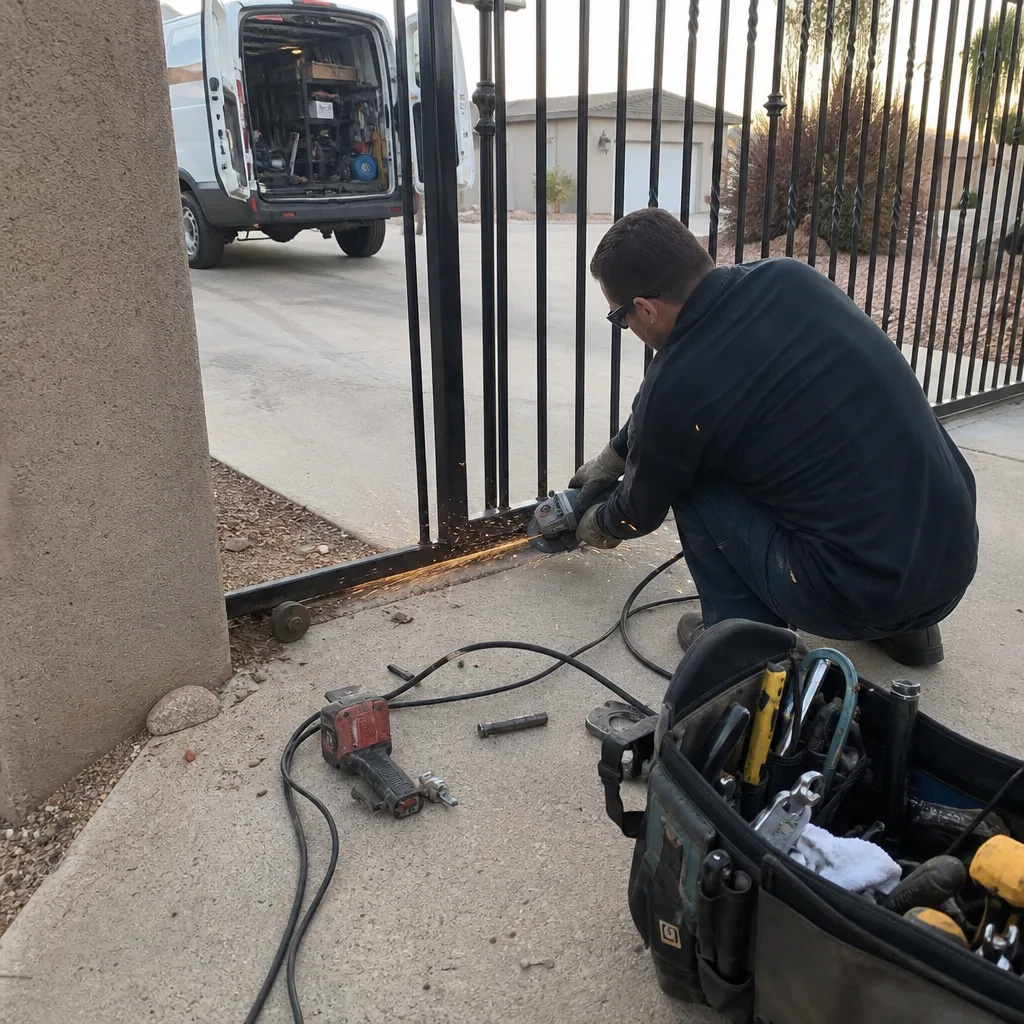
- Why the DIY Question Is Really a Documentation Question
- The Safe-DIY List: Four Things That Leave No Liability Footprint
- The Stop-Here List: Four Jobs That Erase the Baseline
- How to Record Your Gate’s Current Settings Before Anyone Touches It
- Permit Triggers in Boulder City: When DIY Becomes a Licensed Job
- What to Hand a Professional When DIY Didn’t Fix It
- Common Mistakes to Avoid
- When to Call a Professional
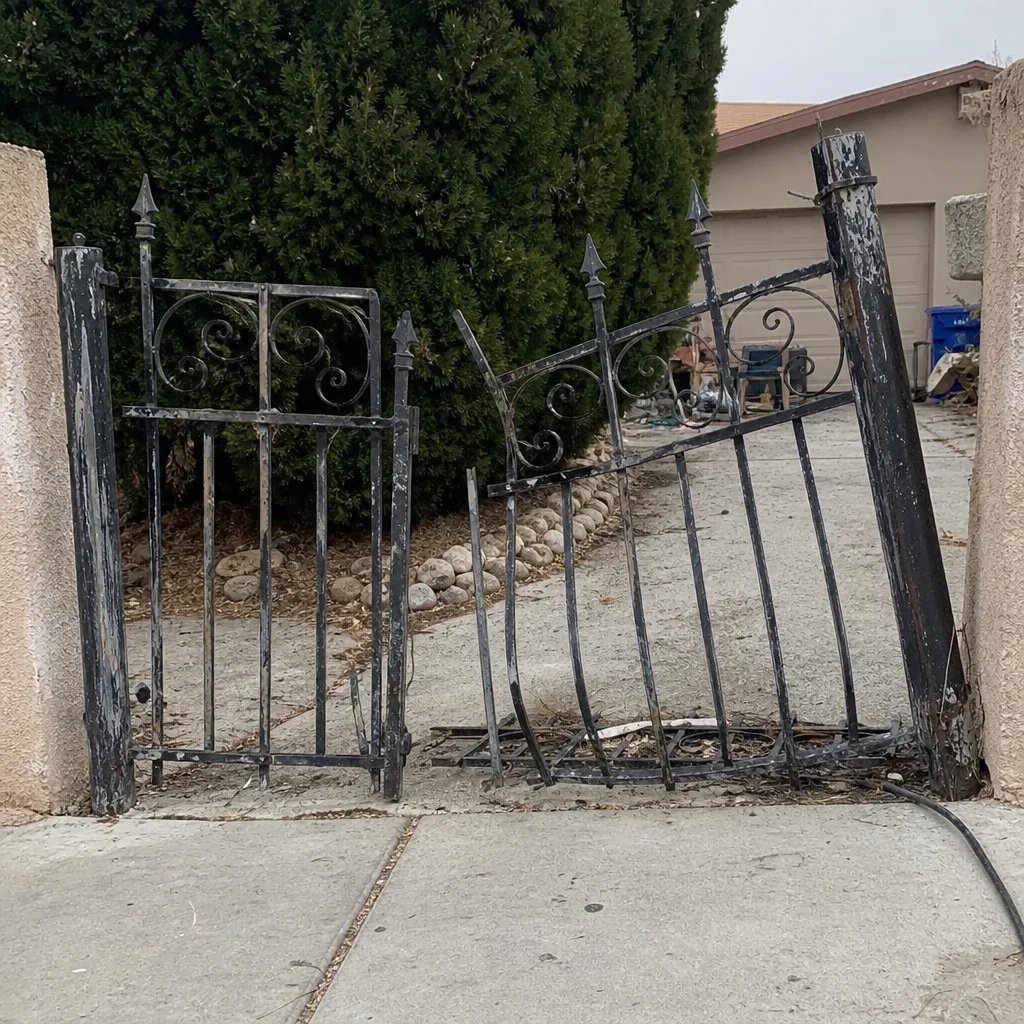 Before
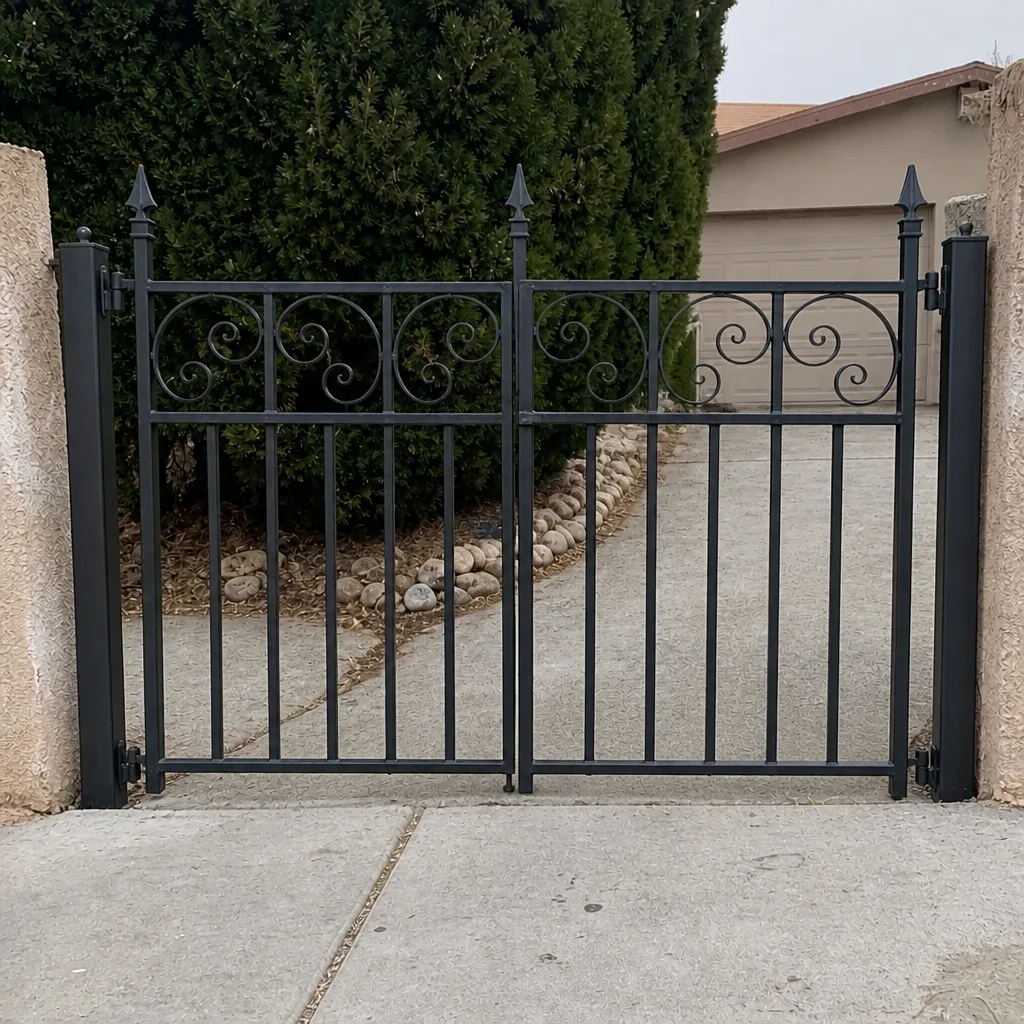 After
Why the DIY Question Is Really a Documentation Question
Most DIY guides sort tasks by difficulty. That’s the wrong metric. A gate repair has two costs: the cost of the part and the cost of the information the repair destroys. Difficulty tells you nothing about the second one.
Think about what happens on a documented visit. Under The Haven Standard, every job here leaves a photo log of what was found, what was set, and what was installed. The limit-switch readings get photographed. The wiring gets diagrammed. Six months later, when the gate stops reversing correctly, the next technician opens that record instead of guessing from scratch. That’s the whole point of gate motor & opener work in Boulder City being recorded rather than improvised.
Now picture the same gate after a homeowner has turned the limit cams a quarter-inch to stop the gate hitting a stop post, without noting where they started. The technician arrives to a symptom with no baseline. Diagnosis that should take twenty minutes takes an hour. You pay for that hour.
Boulder City driveways make this worse in a specific way. The desert temperature swing between a July afternoon and a July night runs close to 30 degrees, and metal gate frames and operator arms expand and contract across that range. A limit setting that feels correct at 2 p.m. can bind at 6 a.m. Homeowners here adjust for the hot reading, then the gate misbehaves in the cool of morning and the reading gets adjusted again. Two undocumented changes in a week and the original factory position is gone.
That’s the real dividing line. It isn’t “can I physically do this?” It’s “will doing this leave the gate harder to fix than it was.”
The Safe-DIY List: Four Things That Leave No Liability Footprint
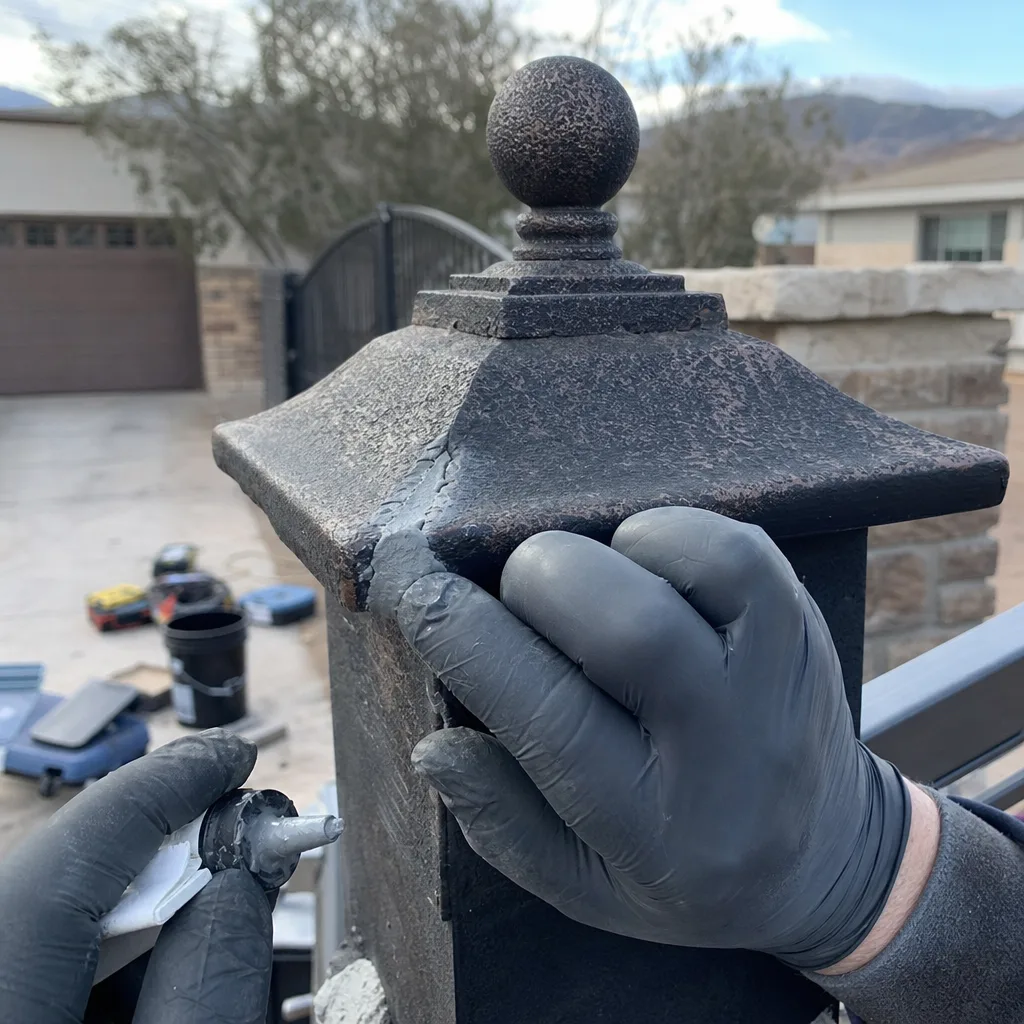
These four tasks are safe, sensible, and worth doing yourself. Each one has a clear reason it carries no downstream cost.
- Replacing a remote battery. A CR2032 or A23 swap changes nothing about the operator. No settings move, no wiring is touched, and the gate’s programming is untouched. If the remote still doesn’t work after a fresh battery, you’ve ruled out the cheapest possible cause and that’s useful information for whoever looks at it next. Nothing is lost.
- Operating the manual release. Every automatic gate has a release – a key, a lever, or a pull chain depending on the brand. Learning to use it during a power cut is exactly what it’s for. The one rule: release the gate only when it’s stationary, never mid-travel, and re-engage the arm fully before running the motor again. Done that way, the release leaves no trace.
- Clearing debris from the sensor path. On a Ghost Controls or Linear setup, the photo-eye (the infrared beam that stops the gate if something crosses its path) sits low and collects leaves, gravel, and in Boulder City, tumbleweed. Clearing that path with a broom is maintenance, not repair. It can’t damage anything and it solves a surprising share of “my gate won’t close” calls.
- Visual rust inspection. Walk the frame and hinges with a flashlight twice a year. Look at weld joints, the bottom rail, and the hinge pins. You’re gathering information, not changing anything. A photo of a rust bloom gives a welder something concrete to quote against, which is genuinely helpful.
Notice the pattern: none of these four move a setting, cut a wire, or change a physical position. That’s the test to apply to anything not on this list.
The Stop-Here List: Four Jobs That Erase the Baseline
These four come up constantly, and every one of them is a job where the documentation matters more than the repair. This is where DIY stops being thrifty.
- Limit-switch adjustment. The limit switches tell the operator where the gate’s open and closed positions are. Turning them without recording the original readings means the factory baseline is gone. Worse, on most operators a limit mis-set far enough to over-travel can strain the gearbox, and manufacturers treat undocumented tampering as a warranty question. We’ve seen a Boulder City gate fail a warranty claim over exactly this, on a unit that was eleven months old.
- Wiring splices. Splicing a control or power wire without a diagram of what connected to what leaves the next technician reverse-engineering your work. It’s also the one item on this list with real electrical hazard – gate operators run on line voltage at the control box, and a bad splice at the wrong terminal can energize a frame that should never carry current. That’s not a job to learn on.
- Post realignment. A gate that’s dropped or sagging usually has a post problem, not a gate problem. Straightening a post means digging, resetting in concrete, and re-hanging the leaf so the operator arm geometry is correct. Get the geometry wrong and the motor works against itself every cycle until something fails. Concrete work on a gate post in Boulder City’s caliche-heavy soil is a different job than most homeowners expect.
- Control board replacement. Boards are brand-specific – a BFT board and a Viking board share nothing but a shape. Swapping one without photographing the original terminal assignments and DIP-switch positions means the new board has to be programmed from zero, and any custom settings (soft start, obstruction sensitivity, auto-close delay) are lost with the old one.
For any of these, the professional route is the cheaper one over a two-year view. A proper gate repair in Boulder City leaves a written scope and a photographed record; a DIY attempt on this list leaves a puzzle.
How to Record Your Gate’s Current Settings Before Anyone Touches It
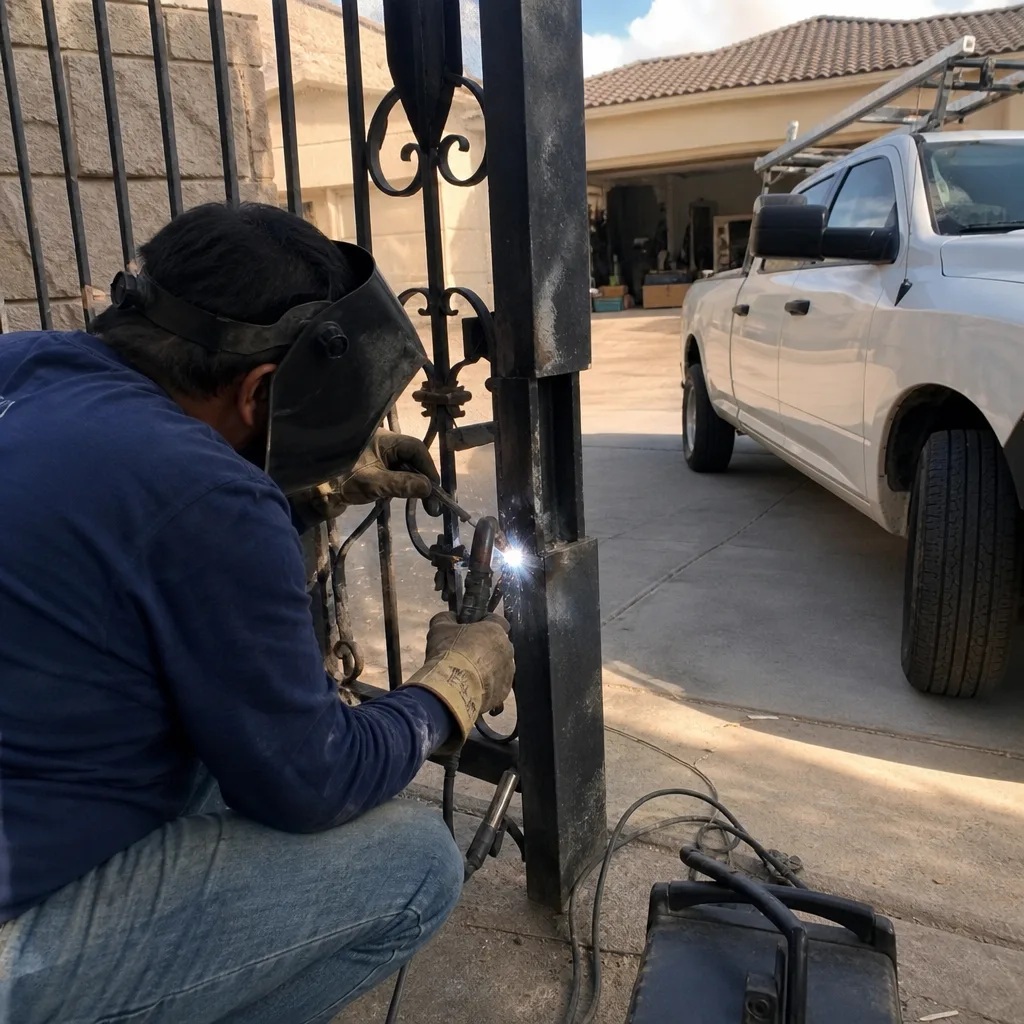
If you’re going to touch anything on the operator – even something small – spend ten minutes building a baseline first. This is the single habit that keeps a DIY repair from becoming an expensive unknown.
- Photograph the control box with the cover off, before any change. Get a wide shot showing every wire’s position and a close shot of each terminal block. Flash on, straight-on angle, no shadow across the terminals.
- Photograph the DIP switches and any dials or trim pots. Note their numbers or clock positions. These set things like obstruction sensitivity and auto-close timing, and they’re easy to bump.
- Photograph the limit cams on the operator rail. A close shot showing the cam position relative to the rail marker is often all a technician needs to restore travel if something gets moved.
- Write down the model and serial number from the operator housing. It’s usually on a plate under the cover or on the arm. This tells a technician which brand and version they’re dealing with – invaluable when the motor is a Linear or a Ghost Controls unit with several revisions.
- Note the manual release position – engaged or released – and the gate’s open and closed stopping points, ideally with a photo of the leaf against each stop.
- Save those photos somewhere you’ll find them again. Text them to yourself, put them in a labeled folder, or email them. A photo buried in a camera roll is no better than no photo.
Do this once and you’ve created the documentation the operator came with from the factory – the same record we photograph on every visit under Clause 4 of the Haven Standard, evidence on every job at no additional charge. If you’d like a baseline recorded properly on your own gate, our Vance Gate Repair Boulder City home page is the place to start.
Permit Triggers in Boulder City: When DIY Becomes a Licensed Job
Nevada draws a fairly clear line between homeowner maintenance and contractor work, and it lives in NRS 624, the state’s contractor licensing statute. Understanding where that line falls tells you when a repair stops being yours to make.
The general principle under NRS 624 is that work on a structure for which a building permit is required, when performed for pay, must be done by a licensed contractor. For a homeowner working on their own property, the more practical trigger is different: any repair that requires a building permit, or any work on the electrical supply to a gate operator beyond a plug-in connection, is where the line sits.
In practice, in Boulder City, these are the repairs that cross it:
- Anything involving new or altered electrical circuits to the operator. A licensed electrician handles the power run; a homeowner plugging into an existing outdoor outlet does not cross the line.
- Post replacement or resetting in concrete where the post supports a gate leaf and a permit is required for the structure.
- Replacing a gate operator on a commercial or shared-access driveway, where the work falls under contractor licensing and inspection.
- Any repair to a gate that serves more than one property, such as a shared HOA entrance – that’s no longer a homeowner repair at all.
Two practical notes for Boulder City specifically. First, if you’re in a historic district near the old downtown grid, exterior structural changes to a gate or wall may need design review beyond the standard permit, so check before you dig. Second, the caliche layer under many Boulder City lots makes post work genuinely harder than the permit implies – a job that looks like a one-day dig can turn into a two-day excavation, which is a strong argument for having a licensed contractor and a written scope before anyone picks up a shovel. If you’re unsure whether your repair crosses the line, call us and we’ll tell you plainly.
What to Hand a Professional When DIY Didn’t Fix It
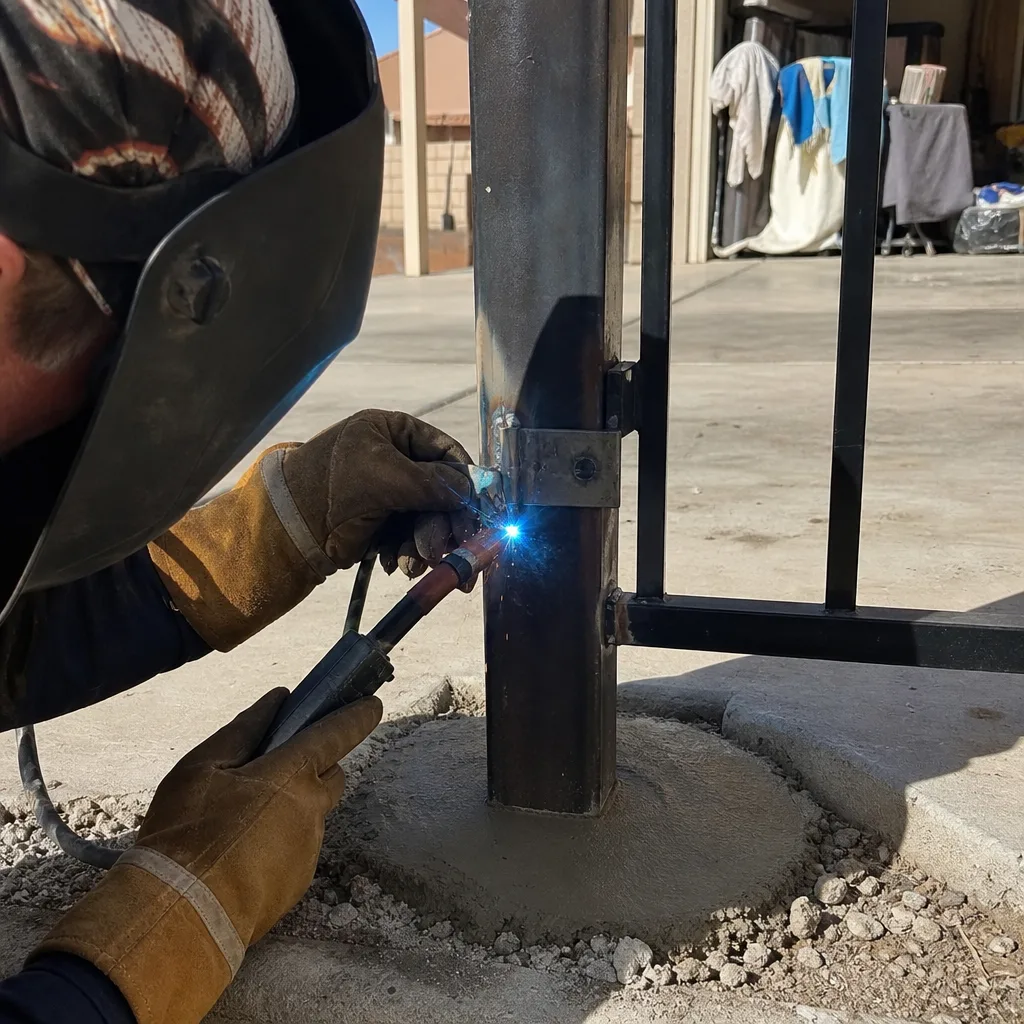
Half of a stubborn gate problem is diagnostic time, and diagnostic time is what you pay for. Hand a technician the right information up front and the bill stays small. Here’s the minimum package that makes a real difference – we’ve watched it cut a two-hour diagnostic to forty minutes more than once.
- What you did, in order, and when. “I cleared the sensor path on Saturday and it still wouldn’t close” is far more useful than “the gate is broken.”
- Any photos you took before touching anything. Control box, DIP switches, limit cams, model plate. If you made a change, the before and after photos together are what restore the baseline.
- The exact symptom and its timing. Does it fail at a certain time of day? Only in cool mornings? Only after several open-close cycles? Heat-related and wear-related failures look identical until you know the timing.
- The operator brand and model, if you can read it. A BFT and a Viking with the same symptom can have entirely different causes, and knowing the brand before arrival means the right parts come along.
- Any written estimate from another company. We review those for free – a second opinion on paperwork is often the moment a homeowner realizes the proposed fix doesn’t match the symptom.
- Whether the power has been interrupted recently, and whether the manual release has been used since. A gate that was manually released and not fully re-engaged shows up as an operator fault that isn’t one.
This package is also why our technicians show up already knowing what they’re walking into. When you call, a live person answers – no voicemail loop, no callback queue – and the conversation starts with your gate, not a form.
Common Mistakes to Avoid
- Adjusting limit switches “just a little” without a photo first. The three-minute fix is the one that most often erases the factory baseline. If you must turn a cam, photograph its position relative to the rail marker before the screwdriver touches it.
- Splicing a control wire with electrical tape and calling it done. Tape splices on gate wiring fail in the desert heat within a season or two, and the intermittent fault they create is one of the hardest to trace. Use a proper connector or hand it to a technician.
- Assuming a sagging gate needs a new hinge. In our experience on Boulder City gates, sag usually traces to the post footing, not the hardware. Replacing hinges on a moving post wastes money and the sag returns.
- Ignoring a slow-closing gate until it stops closing. Auto-close timing drifts as the operator ages, and a gate that’s slow now is often a gate whose springs or arm are wearing. Catching it early keeps the repair small.
- Clearing the sensor path but not checking the beam alignment. Debris isn’t the only thing that blocks a photo-eye; a bumped sensor housing misaligns the beam by an inch or two, which looks exactly like an obstruction. A quick visual check of both housings before assuming the motor is at fault saves a service call.
- Pressing the remote from a distance and blaming the motor. A weak battery in the remote mimics an operator fault. Swap the battery before assuming the worst – it’s the cheapest test there is.
- Handing a technician a verbal description with no photos. The baseline is the whole point. A description without a before photo leaves the technician guessing at what changed, and you pay for the guessing.
When to Call a Professional
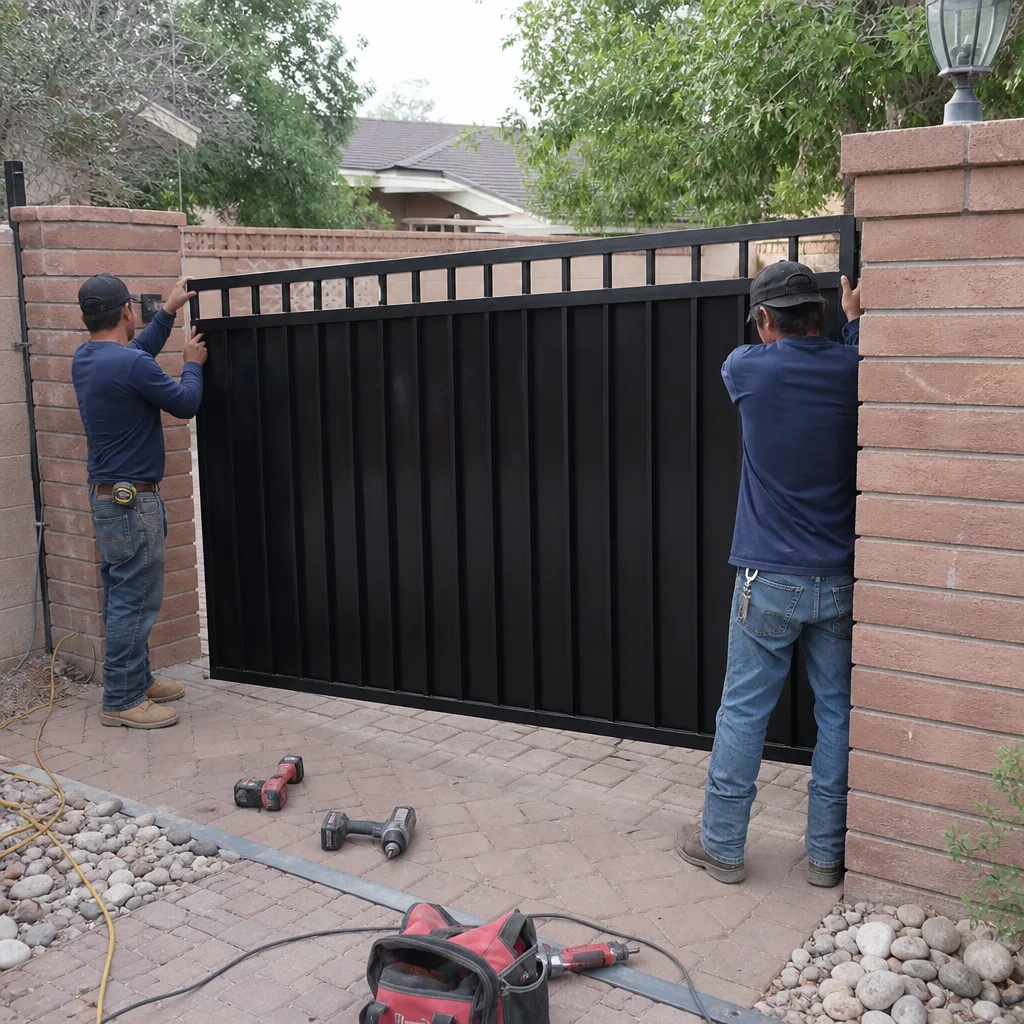
Call us when the repair is on the stop-here list: limit switches, wiring, post realignment, or a control board. Call when a gate stopped responding after a storm or a power cut and a fresh remote battery and a cleared sensor path didn’t solve it. Call when the gate reverses on contact with nothing in its path, jerks mid-travel, or makes a grinding sound you can hear from the house. Call when you’ve reached the point of “I’ll try one more thing” – that’s usually the moment the problem is a documented one, and DIY is adding cost rather than saving it.
Vance Gate Repair Boulder City offers free estimates in Boulder City – call (844) 320-7587 and a live person will pick up, day or night. Every estimate is a written price before any work starts, and every completed visit leaves a photo record on file. If you’re planning a new gate rather than a repair, our gate installation in Boulder City page covers the measured, scheduled side of the work. And if you’re comparing options for a replacement opener, the gate motor & opener in Boulder City guide lays out the brand differences plainly.
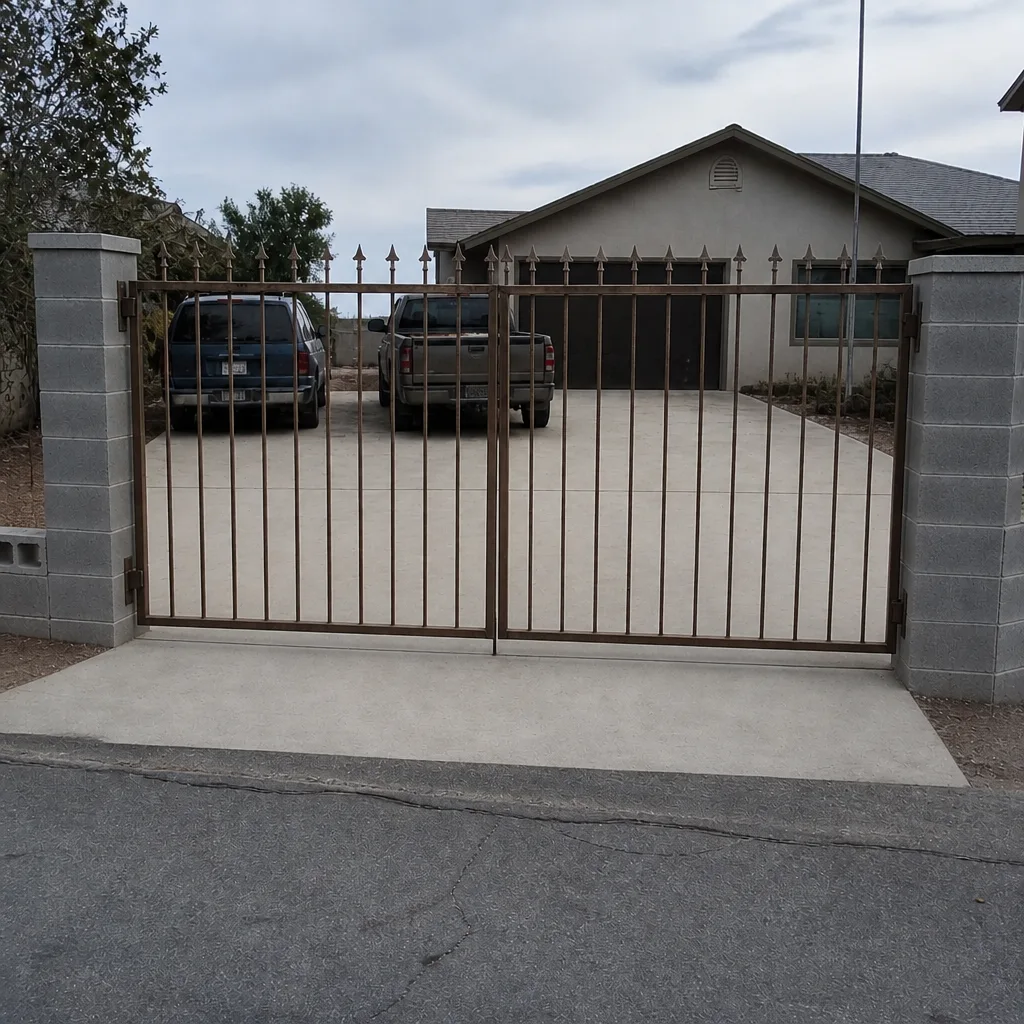
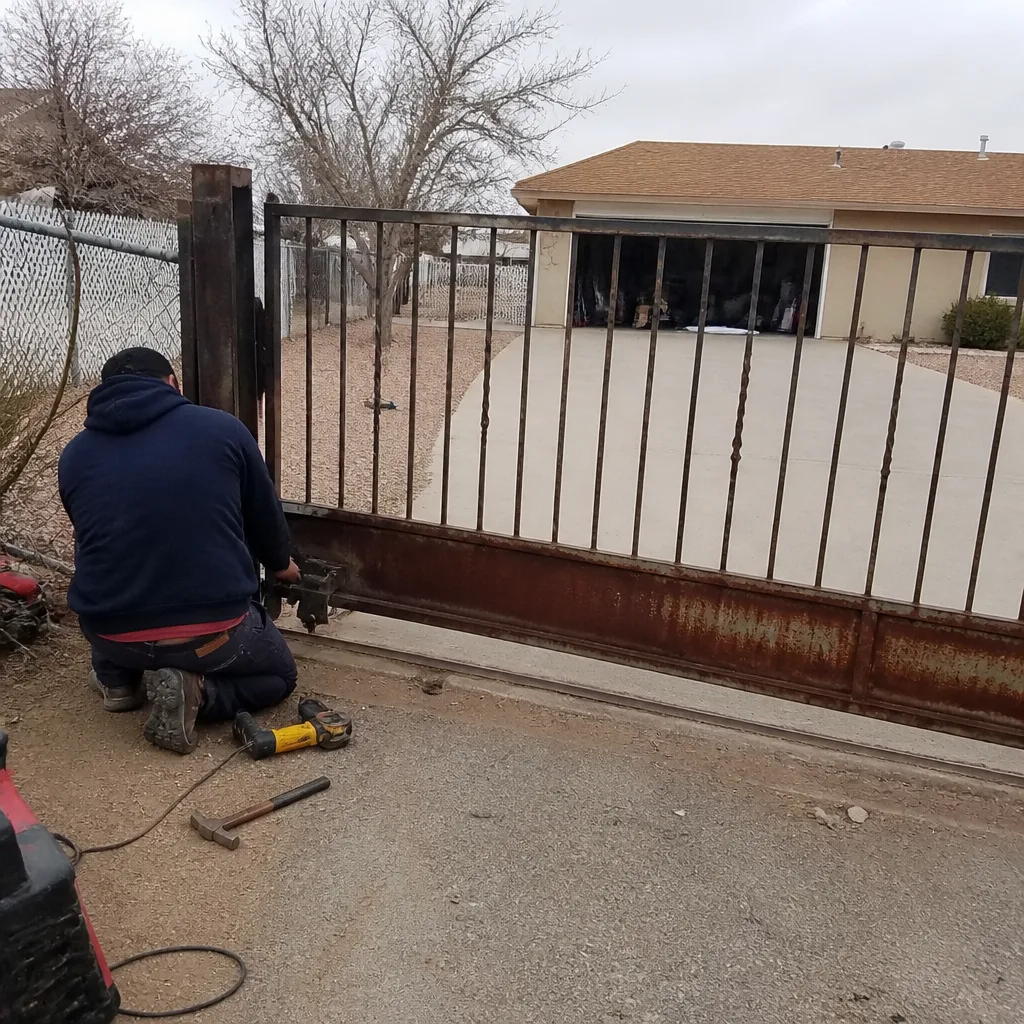
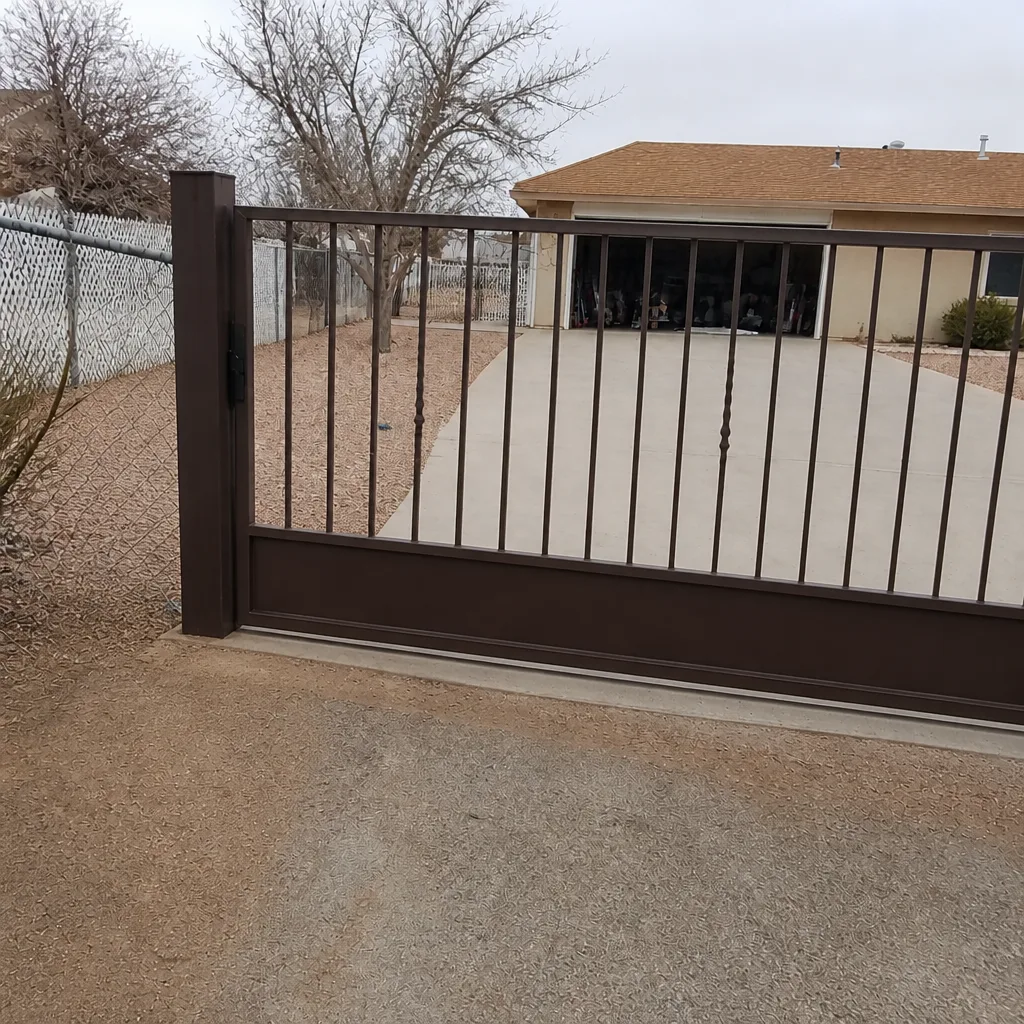
See the difference
BeforeAfter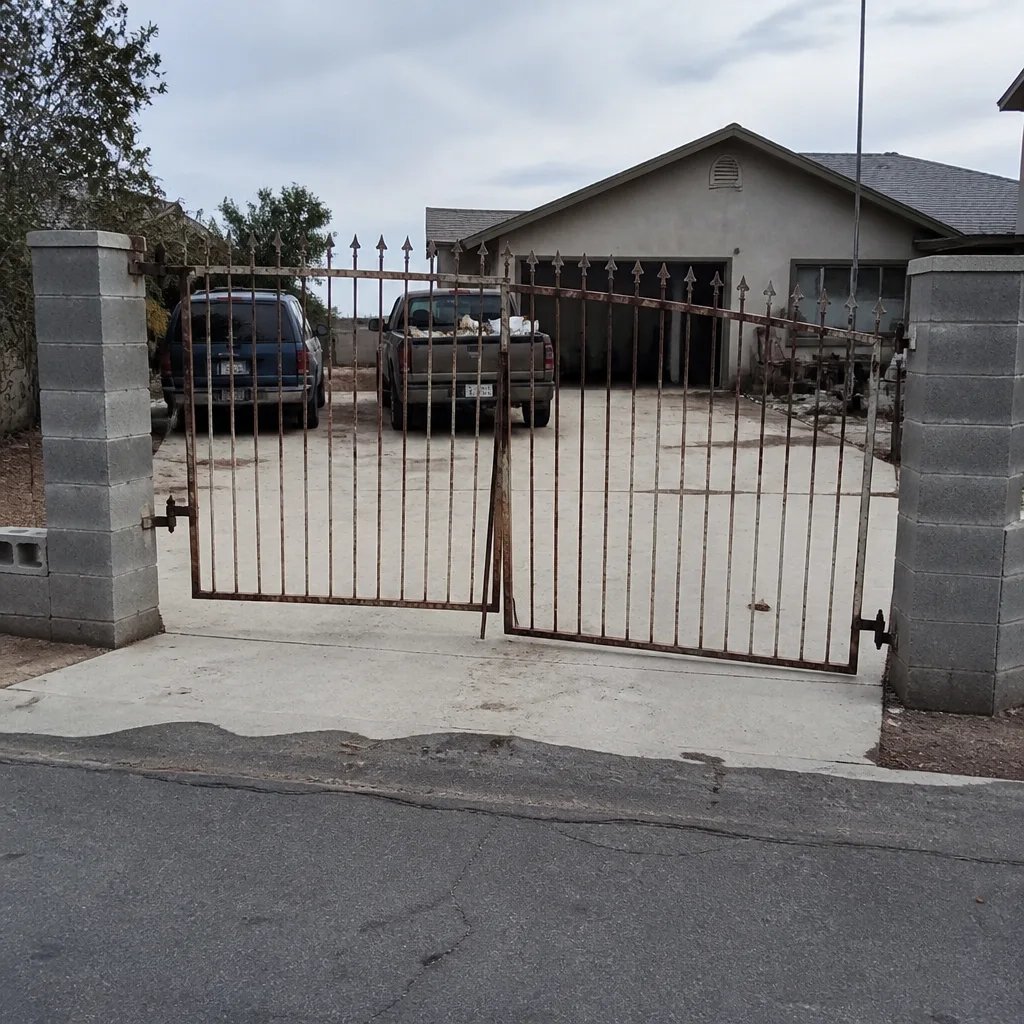 Before
 After
 Before
 After
Frequently Asked Questions
You physically can, but it’s the one DIY action most likely to void a warranty and destroy the baseline a technician needs later. If you do it, photograph the cam position and the control box first, and if the gate still misbehaves, hand those photos to a professional. Call (844) 320-7587 for an exact quote on a limit adjustment – estimates are free.
Replacing a remote battery is the safest, with clearing debris from the sensor path a close second. Neither one moves a setting, touches a wire, or changes a physical position, so neither leaves a downstream cost. Everything else is worth a phone call first.
Often, yes. Leaves, gravel, and tumbleweed collect in front of the photo-eye and block the infrared beam, which tells the operator something is in the way. Sweep the path, check that both sensor housings are still aimed at each other, and try again. If the gate still won’t close, the beam itself may be misaligned and that’s a technician’s job.
No. Gate operator control boxes carry line voltage, and a bad splice can energize a gate frame that should never carry current. Splices also fail fast in Boulder City’s heat. This is a stop-here item – call (844) 320-7587 and we’ll handle the wiring safely and diagram what we changed.
Photograph the control box with the cover off, every terminal block, the DIP switches and trim pots, the limit cams on the rail, and the model-and-serial plate. Those five photos rebuild the baseline if anything gets moved. Save them where you’ll find them again – a photo buried in a camera roll doesn’t help.
Not for routine repairs like battery swaps, sensor clearing, or hinge work. You do cross the permit line for new or altered electrical circuits, post replacement in concrete where a permit is required for the structure, or any repair to a gate serving more than one property. Under NRS 624, work that requires a permit should be done by a licensed contractor – call us if you’re unsure which side of the line your repair falls on.
The Bottom Line
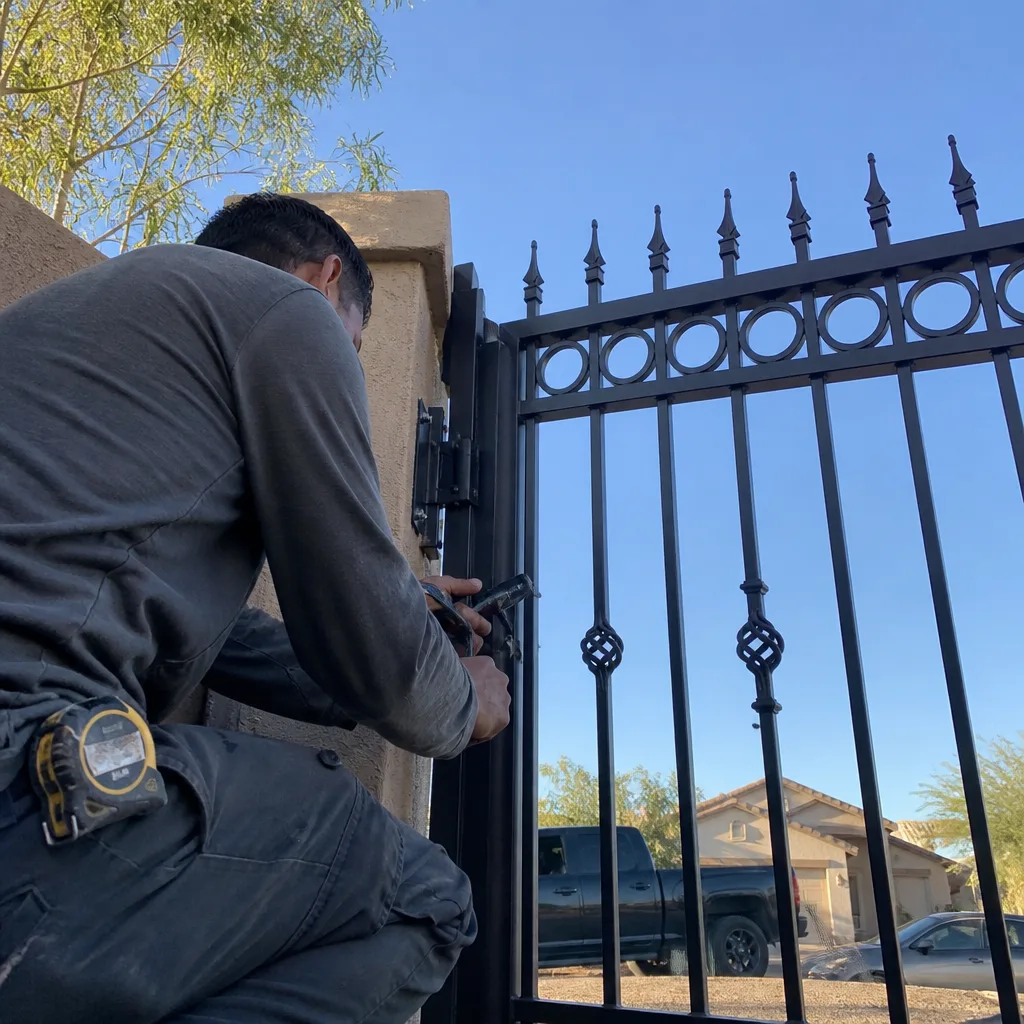
The DIY-or-not question is a documentation question wearing work clothes. Four repairs – battery, manual release, sensor clearing, rust inspection – leave no liability footprint and are worth doing yourself. Four more – limit switches, wiring, post realignment, control boards – erase the baseline and often cost more to fix than to have done right. Photograph before you touch, know where the permit line sits under NRS 624, and bring a written estimate from another company when you want it checked. That habit is the difference between a repair you’ll never think about again and an unpriced problem the next technician has to solve from scratch. In Boulder City, we’ve watched both outcomes enough times to know which one normally wins. Call (844) 320-7587 for a free estimate, written before anyone picks up a tool.
Written by the team at Vance Gate Repair Boulder City.