
Last updated November 18, 2026
 Wrought iron
 Wood & steel frame
 Farm & ranch
 Sliding driveway gates
 LiftMaster operators
Free on-site gate assessment - hinges, posts, and your LiftMaster or Nice gate operator checked before anything is quoted
The assessment is free and the quote is the invoice.
Get your free estimateDIY vs Professional Gate Parts & Welding: What’s Safe to Do Yourself
A decent home welder can run a bead across a cracked gate hinge that looks perfect and passes the tug test in the driveway. Six months later the same joint can crack one inch to the side, because the weld itself wasn’t the failure. The heat did it. Welding a piece of galvanized steel or a high-carbon member changes the metal’s grain structure for an inch or two around every bead – what the trade calls the heat-affected zone – and a homeowner working without engineering context has no way to see that from the outside. That’s the whole DIY boundary on gate work in one sentence: it isn’t about whether you can weld. It’s whether you know what the weld does to the structure around it. In this Boulder City guide we’ll cover exactly which gate repairs are safe to handle yourself, which ones need the load math a professional brings, and how to tell the two apart when you’re standing in front of a broken gate.
Quick Answer
Cosmetic repairs and non-load-bearing hardware swaps (handle latch screws, cosmetic touch-up paint, decorative finial removal, replacing a worn latch bar) are safe to do yourself. Anything that carries gate weight, transfers automation force, or involves welding structural members is not – not because of the welding skill involved, but because the heat-affected zone and load path need to be calculated, not eyeballed. Automated gates, gates over roughly 400 lbs, and gates across shared driveways carry extra liability and should always go to a licensed professional.
Styles & brands we work with
- Wrought iron
- Wood & steel frame
- Farm & ranch
- Sliding driveway gates
- LiftMaster operators
Table of Contents
- What “Safe to DIY” Actually Means in Structural Context
- Why Gate Weight, Cycle Frequency, and Automation Change the Risk Profile
- The Safe DIY List: Surface Work and Non-Load-Bearing Hardware
- Structural Repairs That Need Engineering Context, Not Just Welding Skill
- Liability Scenarios: Automated Gates, Shared Driveways, Heavy Gates
- What to Document If You Do DIY Work
- How to Evaluate a Professional Welding Quote
- The Boulder City Context: Heat, Wind, and Rust
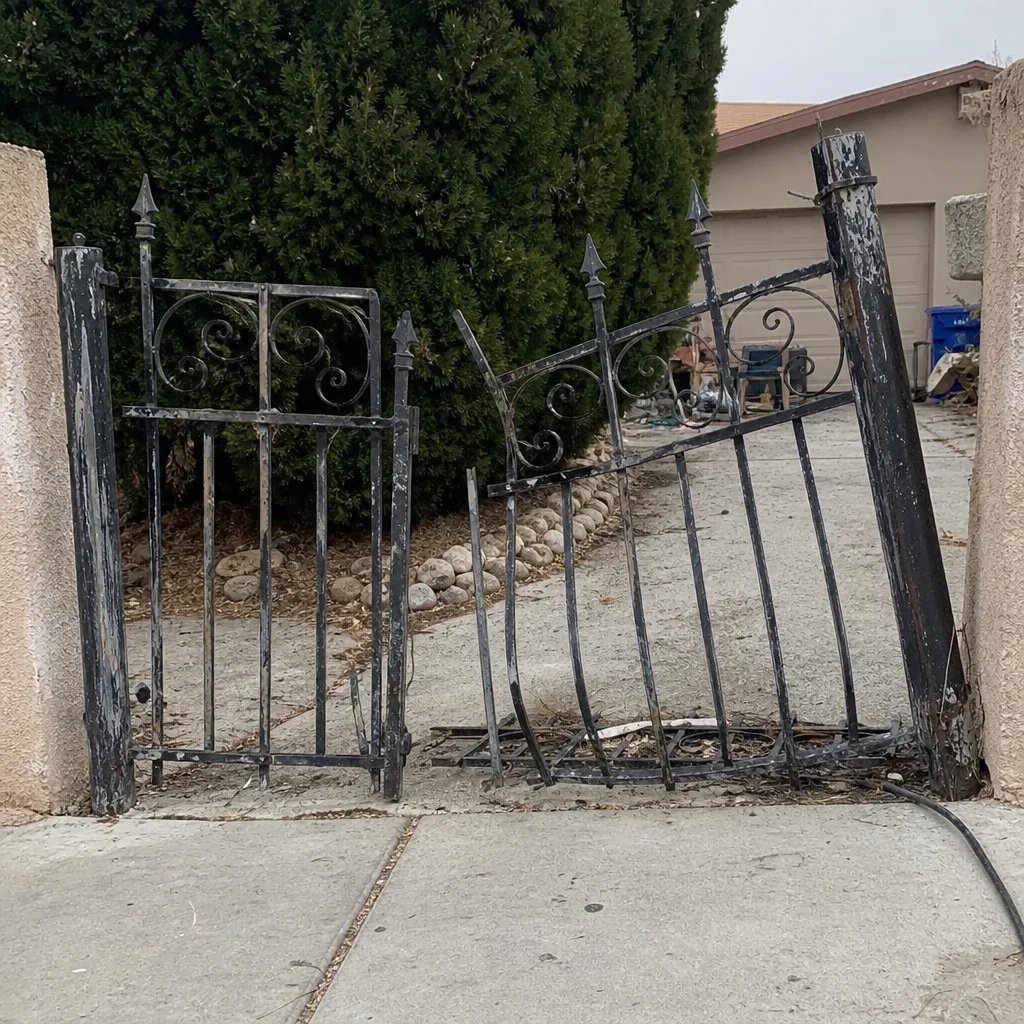 Before
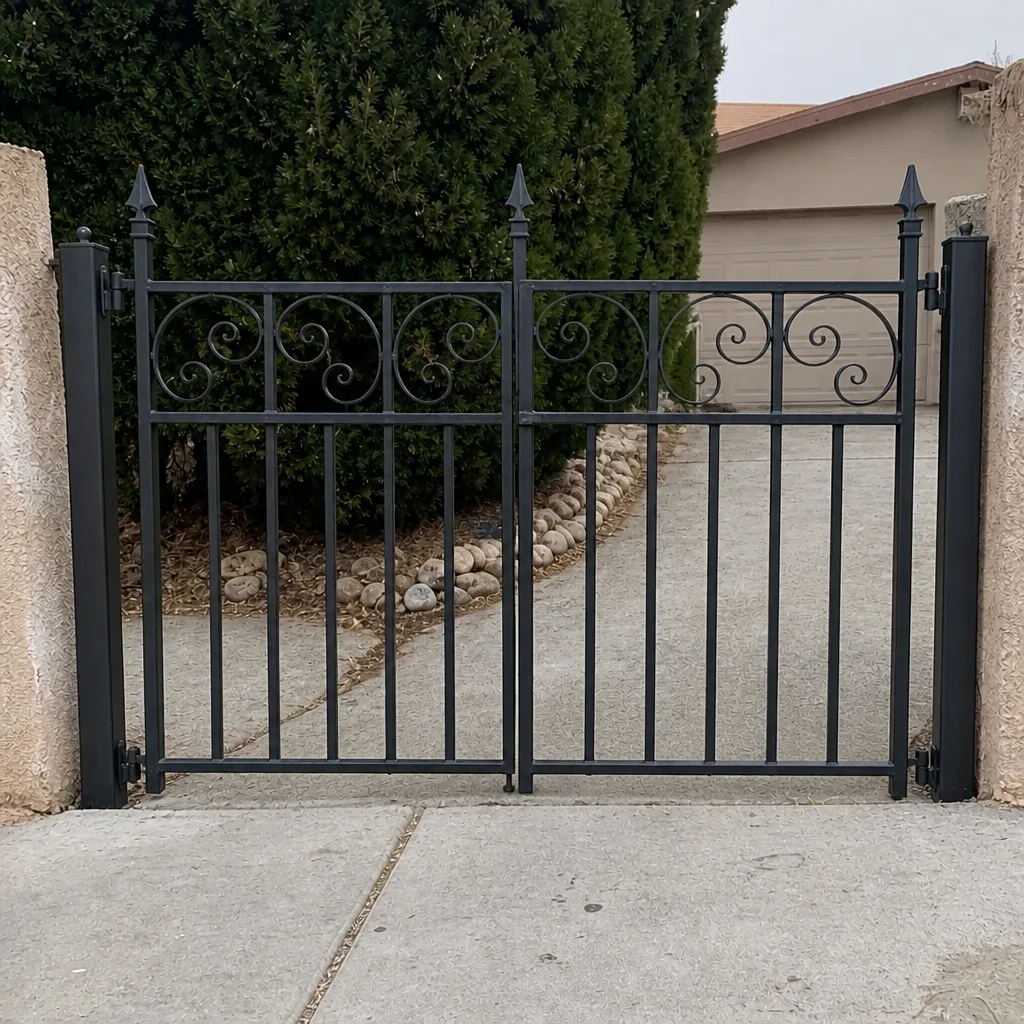 After
What “Safe to DIY” Actually Means in Structural Context
“Safe” on a gate has nothing to do with whether the repair holds up for a week of walking through the gate. It has to do with the load path – the route any force takes from the gate leaf back to the ground. When you replace a latch screw, the load path is unchanged. When you weld a crack on a heavy metal post that supports a 12-foot gate leaf, you’re modifying the load path, and you need to know whether the joint you’re making can carry the horizontal force that gate leaf generates when it’s pushed, when wind catches it, or when the automation slams it against the positive stop.
Here’s the distinction that matters:
- Surface work – paint touch-up, rust removal before painting, cleaning a hinge pin. The metal underneath is unchanged.
- Non-load-bearing hardware – latch bars, handles, decorative caps, signage brackets, photo-eye mounting brackets. Removing or replacing these doesn’t transfer gate weight or automation force.
- Cosmetic welds – filling a cosmetic hole on a non-structural finial, tacking a decorative scroll back onto a panel. If the piece being welded carries no weight and isn’t part of a fabrication that must survive force, this is genuinely safe.
- Structural joints – anything that holds the gate leaf to the post, holds the post in the ground, transfers the automation arm’s force into the gate frame, or supports the weight of the gate itself. These need load math.
In our experience repairing gates around Boulder City, the calls we get after a failed DIY weld are almost never cosmetic. They’re structural joints that bubbled along fine for months until a specific stress condition showed up: a wind event, a heavy delivery truck idling in the driveway, the automation arm reversing hard against the stop.
Why Gate Weight, Cycle Frequency, and Automation Change the Risk Profile
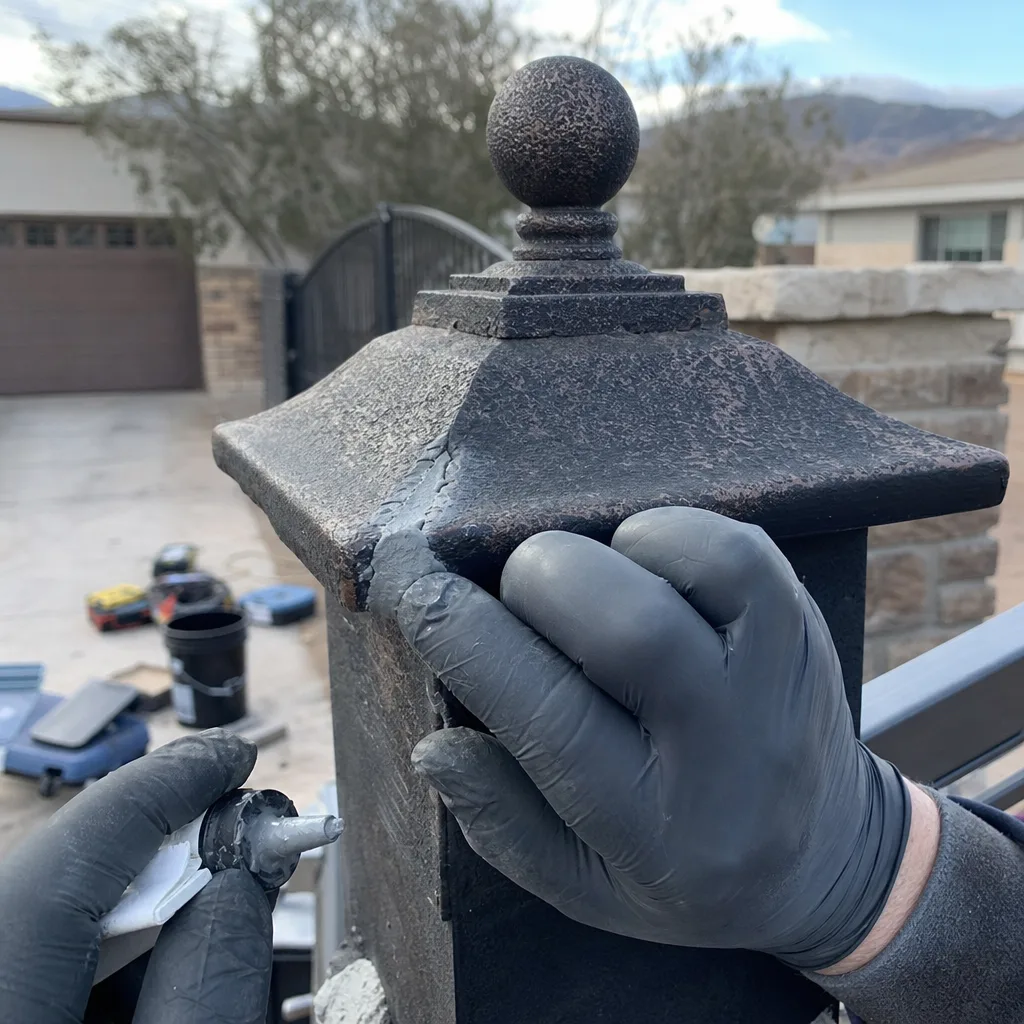
Two identical-looking welds on two identical gates can have wildly different failure timelines, and it comes down to three variables that the homeowner almost always underestimates.
Gate weight
A light aluminum pedestrian gate at 80 pounds can tolerate a lot. A welded steel double-drive gate well over 400 pounds can’t. That’s because a bad weld on a heavy gate isn’t just holding the gate together – it’s holding a leverage load that multiplies every time the gate swings. A structural joint carrying a 400-pound leaf and 14 feet of leverage can pull hundreds of additional pounds of force through the joint every time the gate reaches its travel limit. A weld with a reduced fatigue life from improper heat input can handle one of those events. Twelve a day, for months, it can’t.
Cycle frequency
A gate you open twice a day by hand is an entirely different risk profile from a gate that opens 60 times a day. Automatic gates doing high cycle counts are precisely the environment where tiny weld failures propagate. A crack that starts small in a low-cycle gate might sit there for a year. In a high-cycle gate, it grows.
Automation status
The moment a gate is automated, the motor – whether it’s a BFT, Linear, or Ghost Controls unit – controls the movement instead of a human hand. That means the gate isn’t being moved by someone who’s paying attention to how the gate feels. It’s being moved by a machine that delivers full motor torque every time, whether the gate is aligned or binding. When automation is in the picture, the machine will happily tear apart a structural joint that a careful human would have noticed was misbehaving.
Boulder City summers push this harder than most people realize. Ambient heat near 110°F on a steel gate expands the metal during the day and contracts it at night. Any weld that already had a stress riser (the sharp edge or inclusion where a crack starts) is being work-hardened through a daily thermal cycle. A bad joint doesn’t just sit there in Boulder City. It moves.
The Safe DIY List: Surface Work and Non-Load-Bearing Hardware
The following repairs we consider genuinely safe for a homeowner with basic hand-tool competence. Nothing here changes the load path, and a mistake is annoying, not dangerous.
- Replace a latch bar or latch receiver. Hand-tool surgery on a four-bolt bracket. Match the bar diameter and the receiver hole pattern.
- Replace worn hinge pins (not hinge plates). If the hinge plate is welded to the frame, don’t touch the weld – but a removable pin can generally be swapped from the outside.
- Clean and lubricate hinges, latches, and rollers. A dry hinge is a cycle-count multiplier. Light oil and a rag save you a structural repair later.
- Cosmetic paint and rust touch-ups. Wire-brush light surface rust and prime and repaint. That’s not structural repair; that’s slowing structural repair’s arrival.
- Replace photo-eye brackets, signage brackets, warning labels, and other fittings that mount without holding gate weight. A photo-eye (the infrared safety beam that stops the gate if something crosses the path) is not itself load-bearing, but if its bracket mounts to the same tube holding the gate, use care.
- Replace a low-voltage photo-eye sensor. Same-brand direct swap on a functioning sensor wiring run is a reasonable DIY job. If you’re unsure of the wiring, stop and call.
If you want more depth on the repair side of gate hardware we handle professionally, that content lives on Gate Repair in Boulder City.
Structural Repairs That Need Engineering Context, Not Just Welding Skill
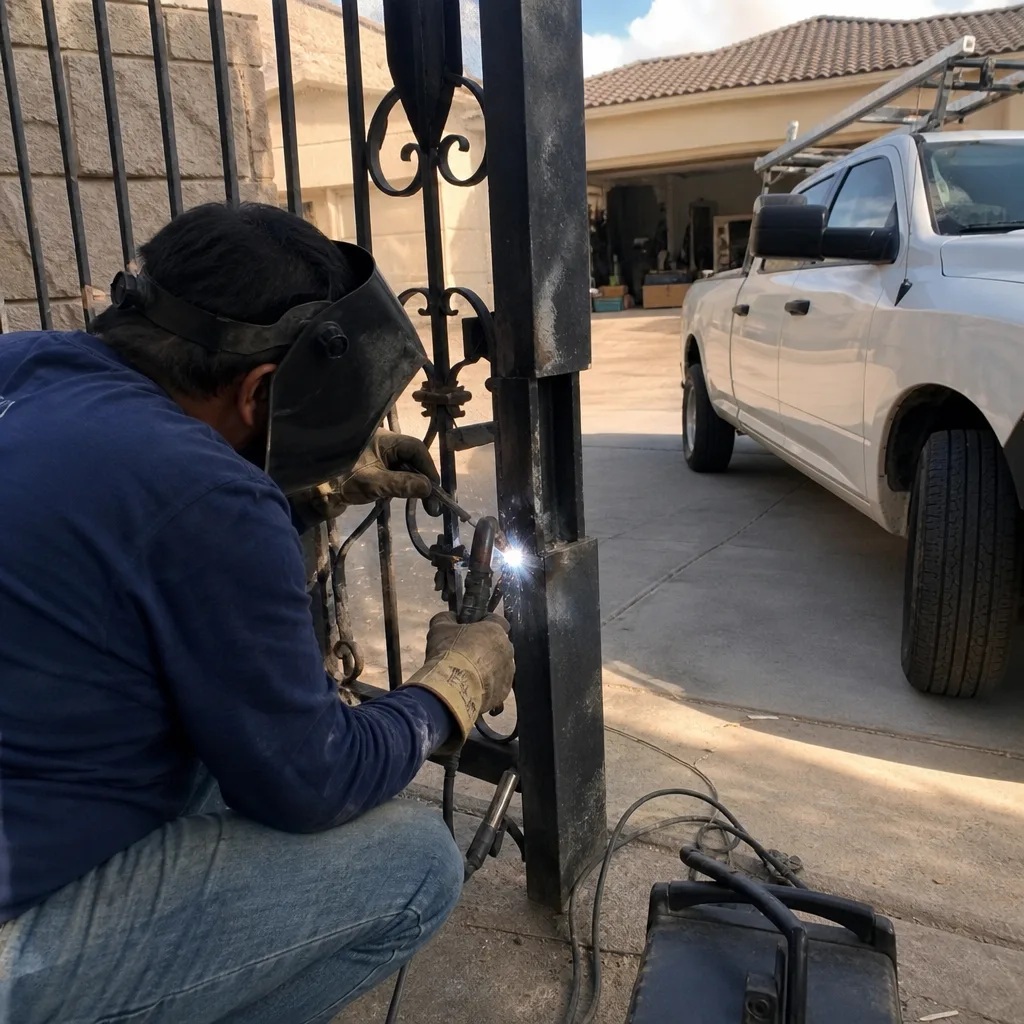
We want to be plain about this part: none of the following should be amateur-welded on a gate that matters. Not because we don’t trust your welding. Because a structural weld isn’t just a metal-joining task – it’s a load-design task, and the weld is only one input.
- Welding a cracked hinge plate to a gate frame. Hinge plates carry the full gate leaf weight plus every swing cycle. A re-weld must account for heat input on the frame member, plate alignment, and whether the original plate size is adequate for the gate’s actual weight.
- Welding a post base or a post repair collar. Post base welds transfer all bending moment from the gate to the ground anchor. A poor weld at the base is the single most common catastrophic failure point we see.
- Welding on the automation arm bracket. The motor arm bracket transfers full motor torque into the gate. A bracket that shifts even slightly throws the limit-switch readings off and forces the motor to fight the gate.
- Repair welding on a gate frame rail or stile. The rails and stiles distribute weight from the hinges through the gate leaf. A bad weld on a rail concentrates load and creates a stress riser.
- Straightening or repairing a bent gate leaf with heat. Heat straightening requires understanding the temper of the steel and the directional load. A homeowner straightening a gate with a torch or a rosebud tip often temper-kills the surrounding steel and creates a permanent weak spot.
- Welding any gate that holds automation force at the positive stops. Positive stops are the physical end-of-travel points that take the gate’s full kinetic energy every cycle. Structural repairs near a positive stop are precisely where fatigue matters most.
If you’re weighing repair versus replacement because the structural damage is extensive, the “when repair makes sense and when it doesn’t” conversation is covered in more depth on Gate Installation in Boulder City. Our position is honest: we repair far more gates than we replace.
Liability Scenarios: Automated Gates, Shared Driveways, Heavy Gates
Three specific conditions change a gate repair from a personal-risk decision into a liability question that can involve insurance, neighbors, and (in Boulder City’s case) the shared-use realities of a smaller city where the same gates are opened a lot every day.
Automated gates
Any gate with a motor on it is subject to safety requirements under consumer product safety standards recognized in every U.S. jurisdiction. The gate is now a machine. If your DIY weld fails and the gate swings into a vehicle, a person, or a pet, the question isn’t “was the weld okay” – it’s “did the repair preserve the safety envelope the automation was designed for.” A heat-affected zone, a warped rail, a joint that shifted the gate’s travel by an eighth of an inch – these all change what the photo-eye was calibrated against.
Shared driveways
If your gate is on a shared driveway, you may not own the whole load path. Half the post-load reaction may be on a party wall or a structural element you don’t control. Welding a repair that modifies the load path on a shared gate without talking to the other property owner is a conversation nobody wants to have after a failure. Get written clearance before you start.
Gates over roughly 400 lbs
Above that weight tier, weld quality becomes a system-level issue. The gate is a structural fabrication, not a fixture. Above 400 lbs, we recommend professional repair for any structural joint, no exceptions. If the gate is also automated, that recommendation gets stronger – the motor doesn’t slow down because the weld is small.
What to Document If You Do DIY Work
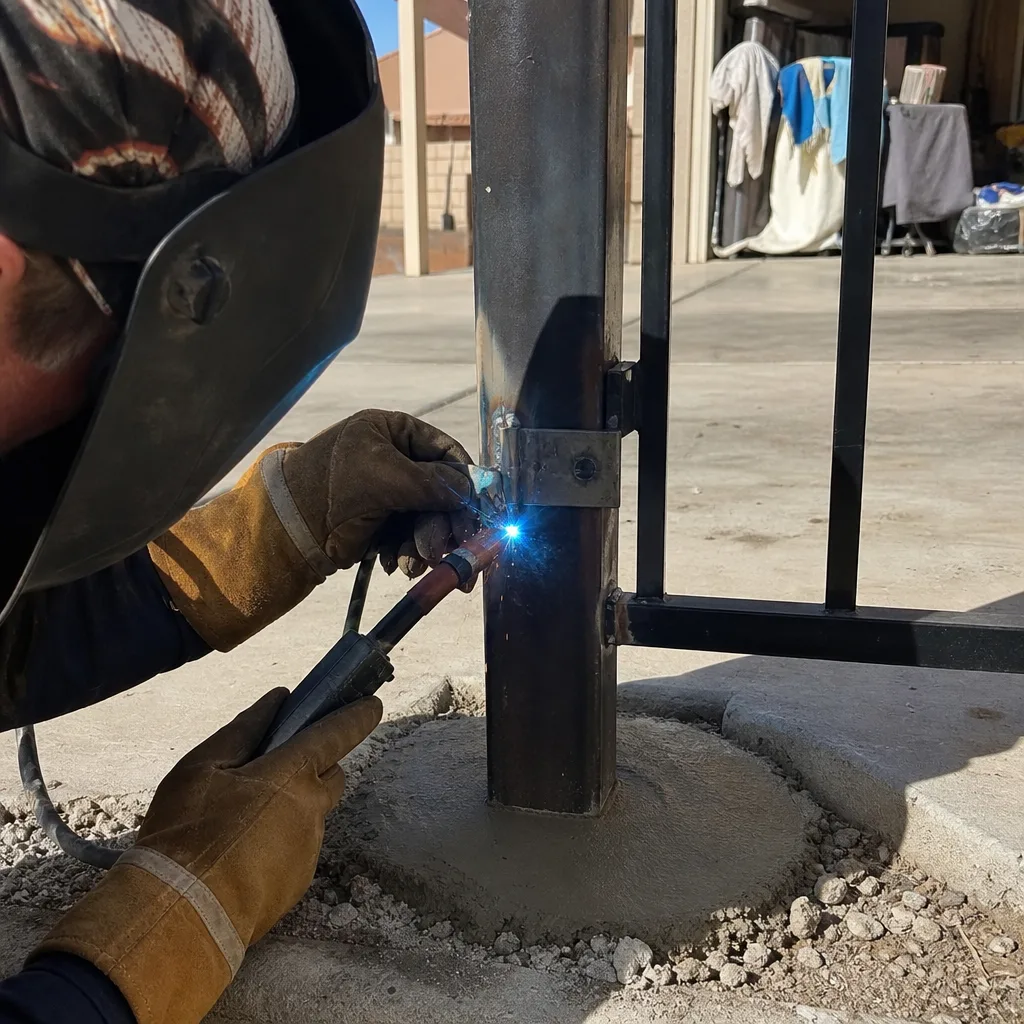
This is where a lot of DIY gate work goes wrong six or seven years later. A future technician arrives to repair the gate and has no idea what the previous repair was, what alloy was used, or where the welds were placed. The gate has to be reverse-engineered from the outside, and the homeowner pays twice for the same basic understanding.
We adopted a documentation habit from commercial access-control work and it applies just as much to DIY. If you’ve done a repair on a gate you own, document it. This is cheap to do and pays back immediately the first time a technician visits.
- Take a photo of the repair before and after. Date the photos. Note the location on the gate (hinge side, latch side, second hinge from bottom, etc.).
- Write down the materials used. Filler rod specification, base metal (if known), any paint or primer used, and current hardware part numbers.
- Record the weld location on a simple sketch or a photo with a marker. “Weld here” is a lot more useful than “somewhere on the hinge side.”
- Note the gate weight and closing force if you’ve measured it – a bathroom scale under one edge and a swing-force gauge are two cheap things that give a future technician real context.
- Record any changes to travel, limit settings, or photo-eye position after the repair. A limit switch set to the wrong travel is the number one thing we correct on arrival.
- Staple the whole packet inside the operator box or a plastic sleeve on the post. Future technicians and future you will both find it.
When we visit a gate, we leave the same kind of packet behind. You can read more about that on Gate Motor & Opener in Boulder City – limit-switch readings, wiring diagrams, and photos of what we found and set. It’s not an add-on. It’s the standard on every visit.
How to Evaluate a Professional Welding Quote
Here’s an uncomfortable truth: not every quote for “professional gate welding” reflects structural scope. Some local operators will treat a structural problem as a cosmetic one – show up, run a bead, invoice, leave – and the homeowner finds out six months later when the same joint cracks again an inch away from the original repair. Here’s how to separate a real structural repair quote from a cosmetic-weld quote.
- Does the quote name the specific structural member being repaired? “Hinge plate on the top hinge, latch side” is a structural quote. “Gate weld” is not.
- Does it mention the metal thickness or the filler spec? A structural quote will usually specify filler rod type and mention metal thickness for the joint.
- Does it account for the gate’s weight and automation status? A structural quote will ask about the motor (BFT, Linear, Viking, Ghost Controls – any of the nine major brands) and the gate’s approximate weight.
- Does it include a post-repair force test? After a structural repair, the gate should be force-tested at the leading edge per the automation standard, and the reading should appear on the invoice.
- Does it account for heat-affected-zone management? Sometimes that means the technician will recommend replacing a section rather than re-welding in place. A cosmetic quote always re-welds. A structural quote sometimes says “we need to replace this piece.”
- Is the price written and handed over before work starts? A verbal estimate is a handshake. Ask for a written scope and a written price. That’s the whole point.
- Does it mention a warranty window? Ask specifically what happens if the weld fails after the technician leaves. If the answer is vague, that’s information.
If you’ve received a written quote from another company and you want a second set of eyes, we’ll review it at no cost. Bring the paperwork. That review is free.
The Boulder City Context: Heat, Wind, and Rust
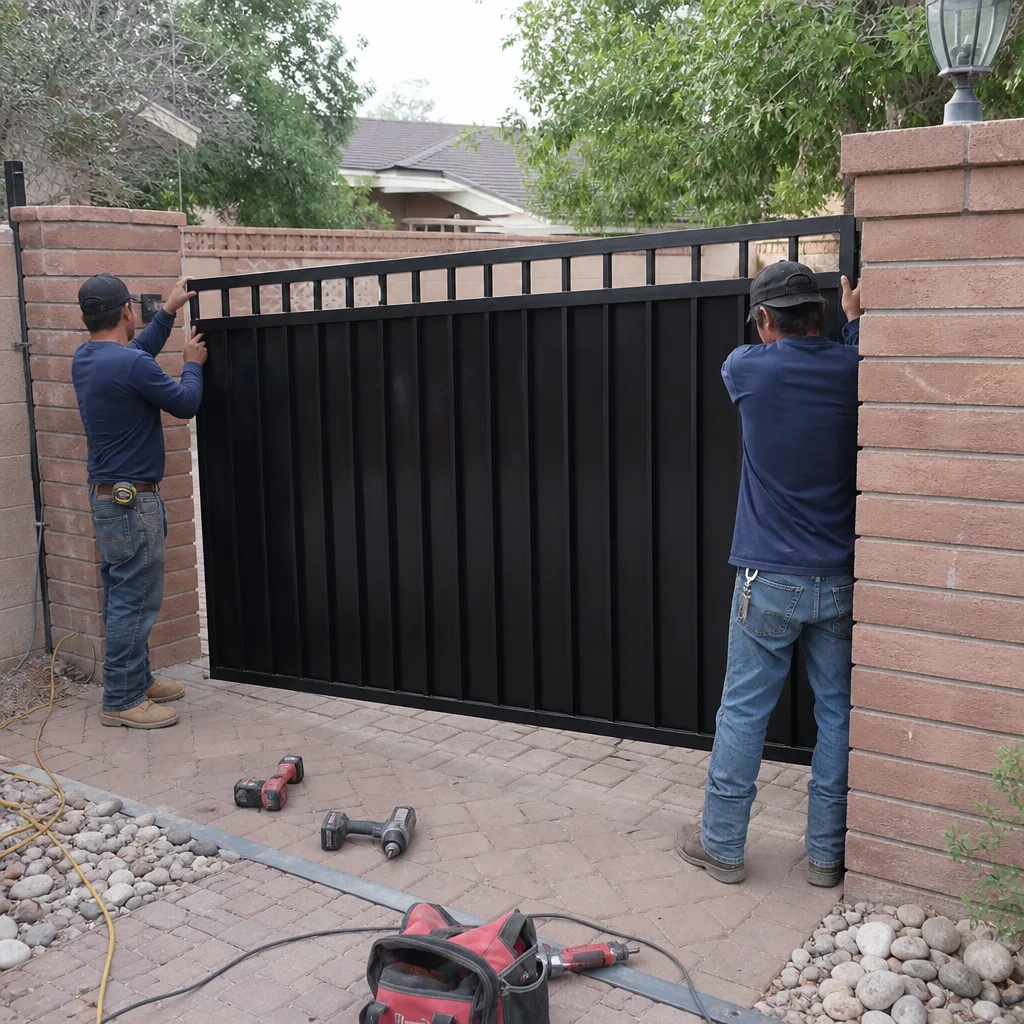
Gate repair in Boulder City has some local conditions that make the DIY boundary sharper than it would be somewhere milder. Heat is the big one. Summer days regularly push past 110°F at the gate, which cycles expansion and contraction across every welded joint every day. Weld steel that’s still got a stress riser – a small inclusion, a sharp joint edge, a slightly uneven bead – and that daily thermal cycle will work that riser open much faster than a homeowner expects. What looks solid in November can crack by the following July.
Wind in the Boulder City corridor adds a second load condition. Any gate with a solid or semi-solid panel catches wind like a sail, and that wind load transfers directly to the hinges and the post base – exactly the two structural members that a DIY weld is most likely to compromise. Rust is the third. Surface corrosion around the weld crown reduces the effective thickness of the member at the exact point where load concentrates. A repair that ignores visible rust at the joint won’t last past the next rainy season.
None of that means you can’t be a competent DIY homeowner here. It does mean that the margin for error on structural gate work is tighter in Boulder City than in a milder climate, and the same repair that would hold for years in a coastal-mild winter can fatigue fast under Boulder City’s thermal swing.
Common Mistakes to Avoid
- Welding over rust instead of removing it. Rust under a weld becomes an inclusion and creates a stress riser. Wire-brush, sand, or grind to bare metal before you strike an arc. In Boulder City, where rust forms faster than you’d expect on gates near irrigation lines, this matters more than it does elsewhere.
- Assuming a clean bead equals a sound joint. A tidy bead on a heat-affected zone is still a weakened member. If the surrounding metal has been overheated by a home welder, the joint can pass a visual inspection and fail a fatigue cycle.
- Re-welding a structural crack without drilling the crack tip. A crack that hasn’t been stopped with a small hole at the tip will propagate right past the weld. This is weld-shop basics and it’s the most common DIY gate mistake we see.
- Forgetting the gate is moving as a system. A structural repair can shift the gate travel, throw the limit-switch reading, and cause the motor to run the gate against the positive stop. After any repair, the whole gate needs the force test and limit check, not just the repaired joint.
- Skipping documentation on a DIY repair. Six years from now, no technician – including future you – will know what was welded or what alloy was used unless you wrote it down.
- Not telling the automation what happened. If you welded near the motor bracket, the travel has likely shifted. Cycling the gate against the mechanical stop is exactly the stress condition a bad weld can’t take.
- Assuming “it held for the whole weekend” means it will hold. A weld that passes Saturday passes Saturday. The load conditions that matters most – thermal cycling over a season, high wind, automation cycle counts – haven’t tested it yet.
See the difference
BeforeAfter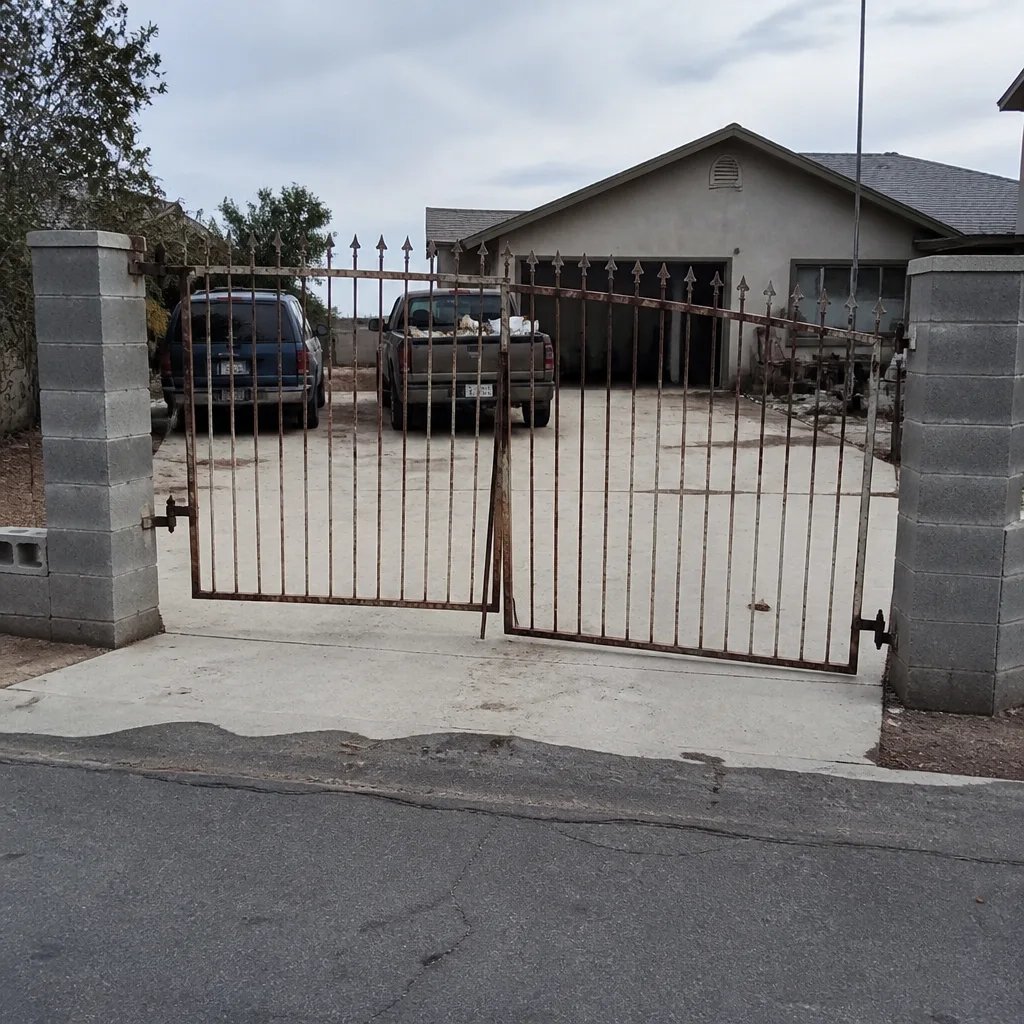 Before
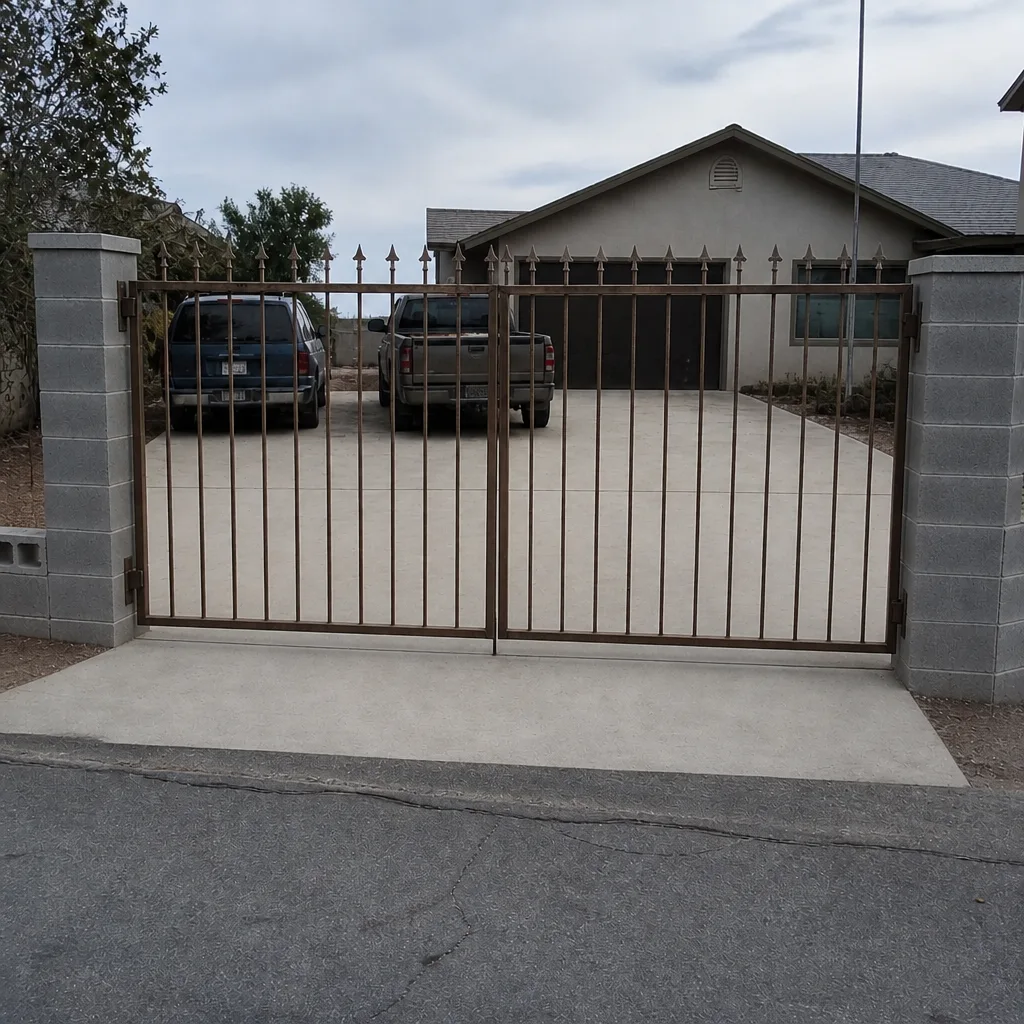 After
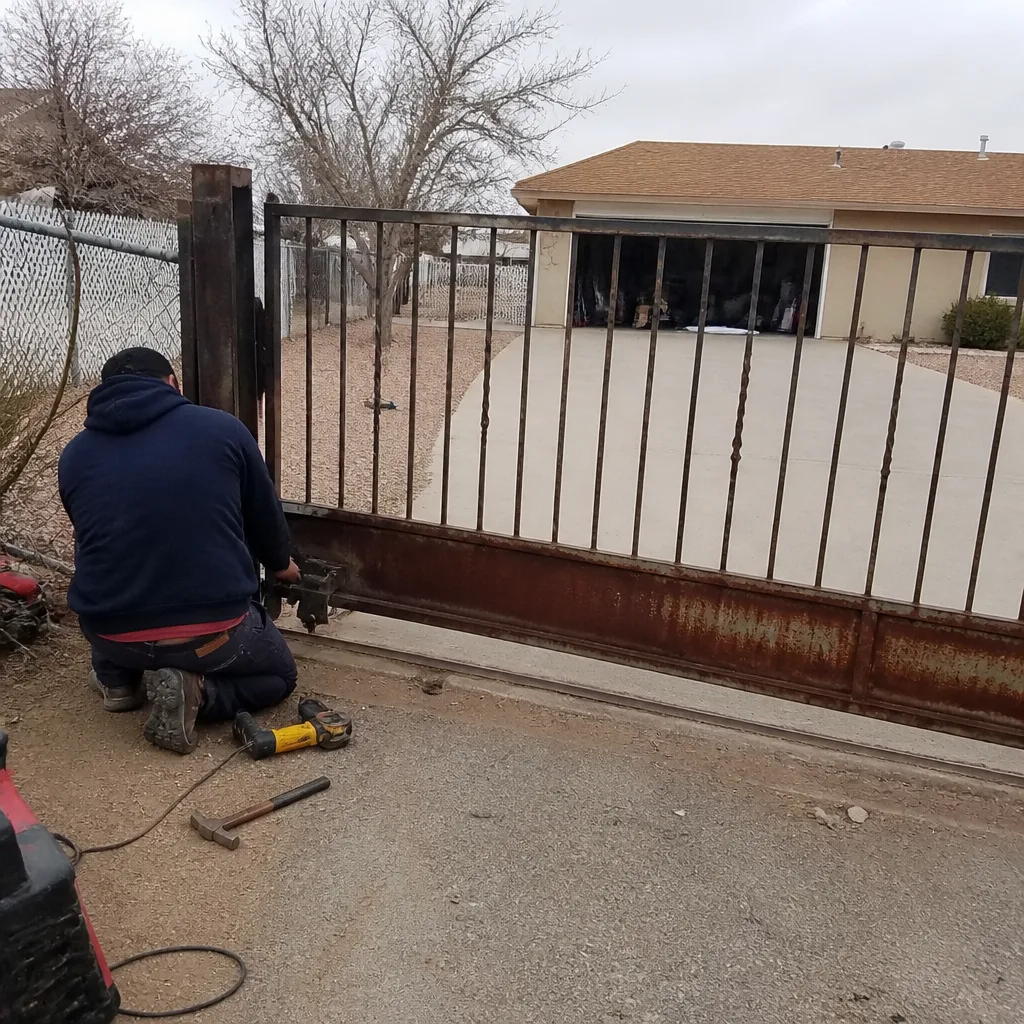 Before
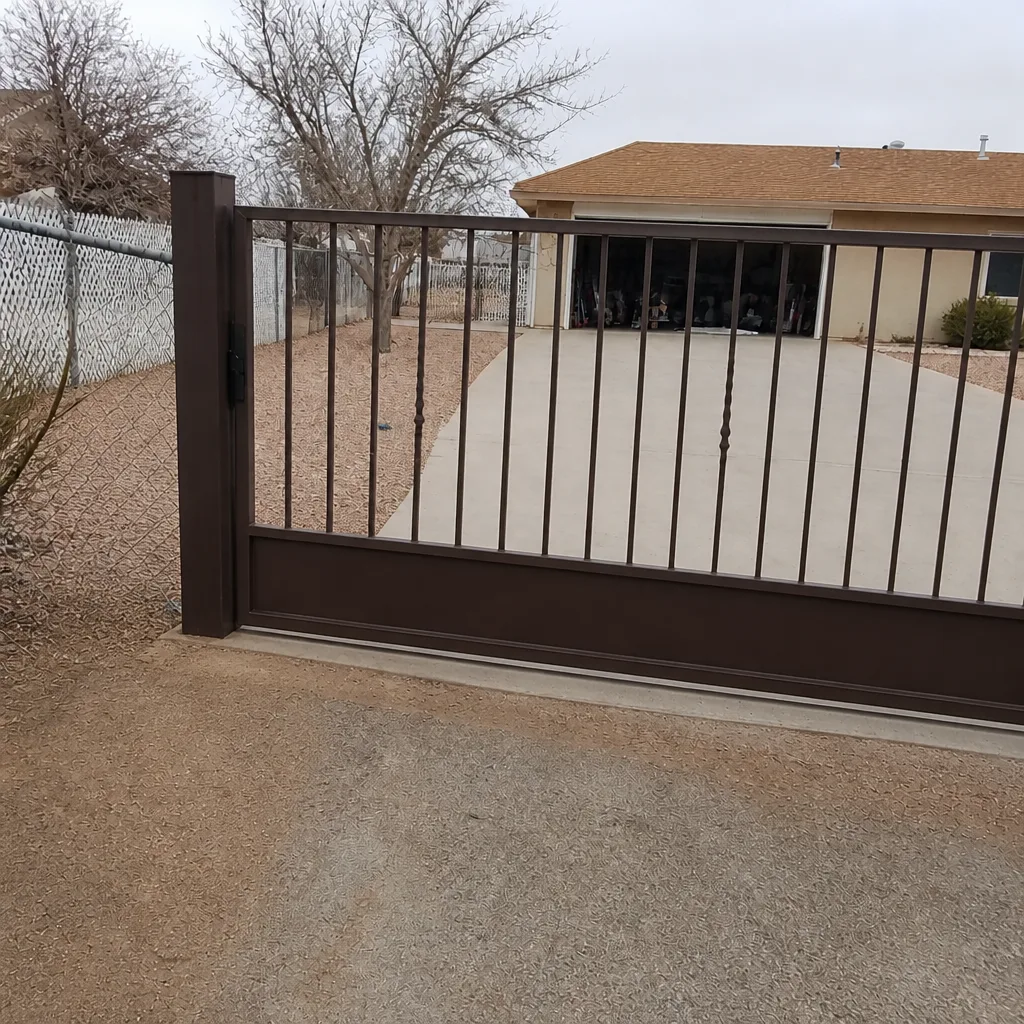 After
When to Call a Professional
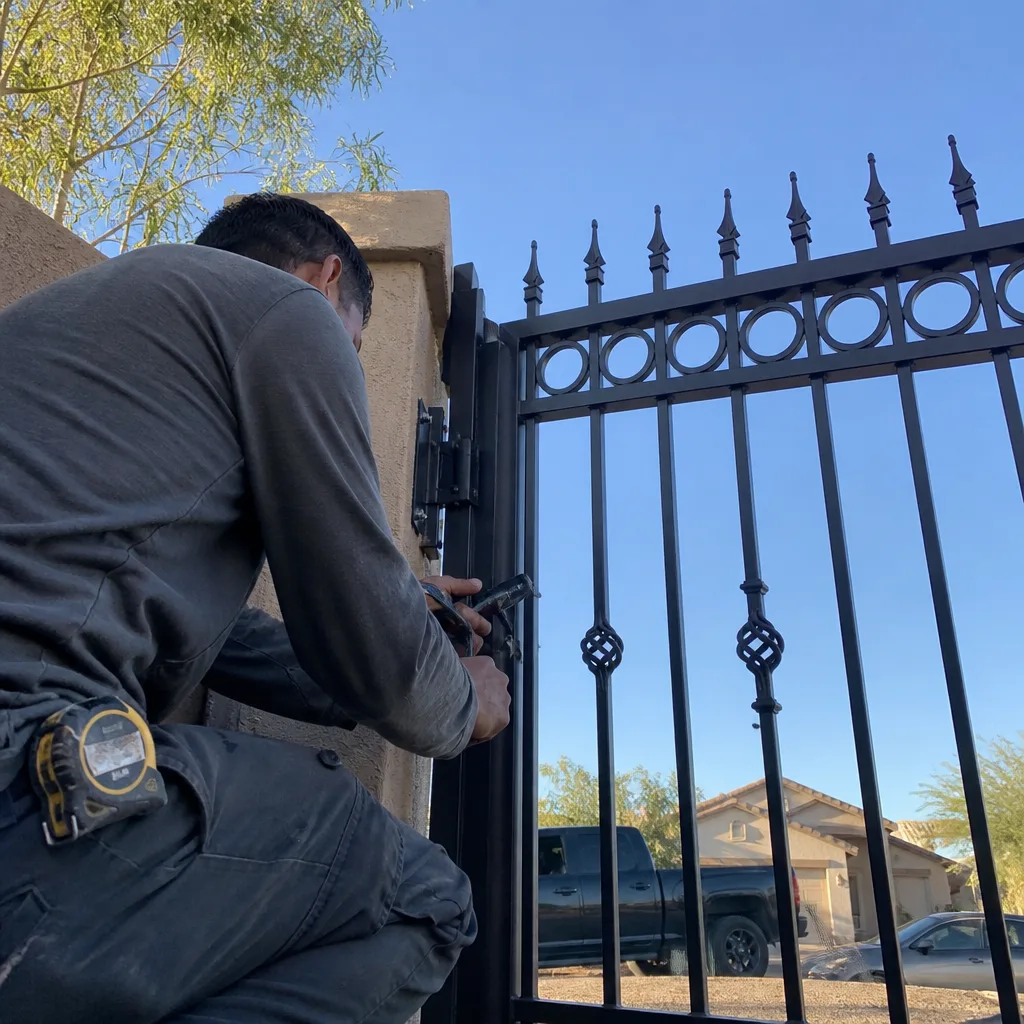
Call a professional for any of these conditions: the repair involves a structural joint (hinges, post base, gate frame rail, automation arm bracket); the gate has a motor on it, regardless of size; the gate weighs over roughly 400 lbs; the gate crosses a shared driveway; the visible crack has propagated past half an inch; or the joint is showing rust through the weld. Our stance is simple: cosmetic and hardware work is genuinely yours to do, and structural work isn’t. Vance Gate Repair Boulder City offers free estimates in Boulder City – call (844) 320-7587 – and our technicians have up to 12 years of experience on gates of exactly this kind. Every visit under The Haven Standard leaves a written price before work starts and a photo record when we leave.
Frequently Asked Questions
Cracks in a hinge plate carry the full gate leaf weight plus every swing cycle, so we don’t recommend DIY welding on a structural hinge. A hinge weld needs load-path context and heat-affected-zone management that a home welding setup generally can’t provide. Call (844) 320-7587 for a written estimate on a structural hinge repair.
No – automated gates carry liabilities a hand-operated gate doesn’t, because the motor delivers full torque on every cycle and safety sensors have been calibrated against the gate’s existing travel. Any structural weld near automation needs the photo-eye and limit-switch readings re-verified afterwards. Estimates on automated gate work are free at (844) 320-7587.
There isn’t a hard number, but as a rule of thumb gates under roughly 150 lbs can tolerate limited DIY structural work with care, and gates above approximately 400 lbs should always go to a professional for structural repairs. Boulder City’s thermal swings accelerate fatigue on lighter gates too, so the margin narrows in the summer months.
A structural quote names the specific member being repaired, specifies metal thickness and filler rod, asks about gate weight and automation status, and includes a post-repair force test. A cosmetic quote typically says “gate weld” and hands over a verbal number. Bring any other company’s written estimate to us and we’ll review it at no cost.
Document it now: photograph the weld location, write down the filler rod and base metal, note any travel or photo-eye changes, and keep the packet with the automation box. A repair that’s holding is fine to leave alone, but a documented record saves every future technician from reverse-engineering your work.
Yes. Bring the written estimate from any other company and we’ll review the scope and the price at no charge. Our focus is on making sure the scope reflects the actual structural work needed, not just the cosmetic bead. Call (844) 320-7587 to schedule.
The Bottom Line
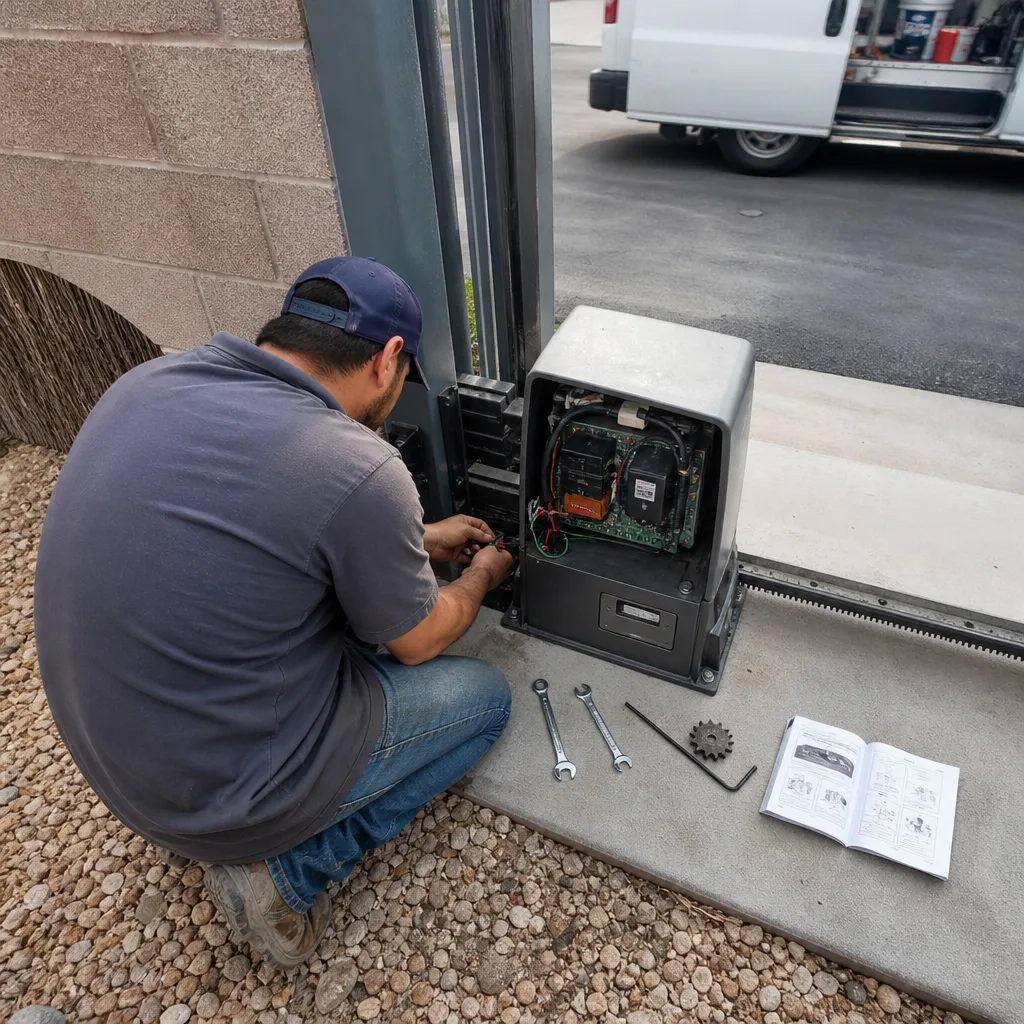
The DIY boundary on gate parts and welding isn’t about skill; it’s about load math. Surface work and non-load-bearing hardware are genuinely safe to handle yourself. Structural joints need engineering context, because a weld that passes a tug test today can halve the metal’s fatigue life under the stress conditions Boulder City’s heat, wind, and automation cycle counts deliver six months from now. If you do a DIY repair, document it – materials, photos, weld locations, travel changes – so a future technician doesn’t have to rediscover it. If you need the structural work done right, with a written price before anyone picks up a tool, that’s what we do. For a start on where the whole line of service begins, Vance Gate Repair Boulder City home is where we keep the full picture. Call (844) 320-7587 for a free estimate – a live person answers 24 hours a day, seven days a week.
Written by the team at Vance Gate Repair Boulder City.