
Last updated November 18, 2026
 Wrought iron
 Wood & steel frame
 Farm & ranch
 Sliding driveway gates
 LiftMaster operators
Free on-site gate assessment - hinges, posts, and your LiftMaster or Nice gate operator checked before anything is quoted
The assessment is free and the quote is the invoice.
Get your free estimateDIY vs Professional Gate Repair: The Boulder City Homeowner’s Decision Guide
DIY gate repair doesn’t cost more because homeowners do it wrong. It costs more because nobody writes down what they did. Six months later, a different technician opens the control box, sees an unfamiliar wire splice and a limit switch set to no known reference point, and bills an hour of diagnostic time to reconstruct what happened. That rediscovery charge is the hidden tax on undocumented work, and in Boulder City we see it on a large share of the gates we’re called to. This guide is about the decision that actually matters: not whether you’re handy enough to touch your gate, but whether the work you do leaves a record the next person can use.
Quick Answer
For most Boulder City homeowners, the right split is this: lubrication, sensor cleaning, battery checks and visual inspections are safe to do yourself as long as you photograph and log what you changed. Anything involving springs under tension, 120-volt wiring, control-board replacement, or repositioning a gate arm on an automated operator should go to a licensed technician, because self-performed work on a UL 325 operator can void the warranty and create liability if the gate later injures someone. The deciding factor isn’t your skill. It’s whether the job produces documentation.
Styles & brands we work with
- Wrought iron
- Wood & steel frame
- Farm & ranch
- Sliding driveway gates
- LiftMaster operators
Table of Contents
- Why Documentation Is the Real DIY vs Professional Question
- What a Boulder City Homeowner Can Safely DIY (And What to Log)
- What Requires Licensed Hands Every Time
- UL 325, Nevada Code, and What Self-Performed Work Actually Affects
- The Documented Cost Difference: Repair With Records vs Repair Without
- The Decision Matrix: Job Type, Safety Risk, Documentation Burden
- How to DIY and Still Create a Usable Record
- Common Mistakes to Avoid
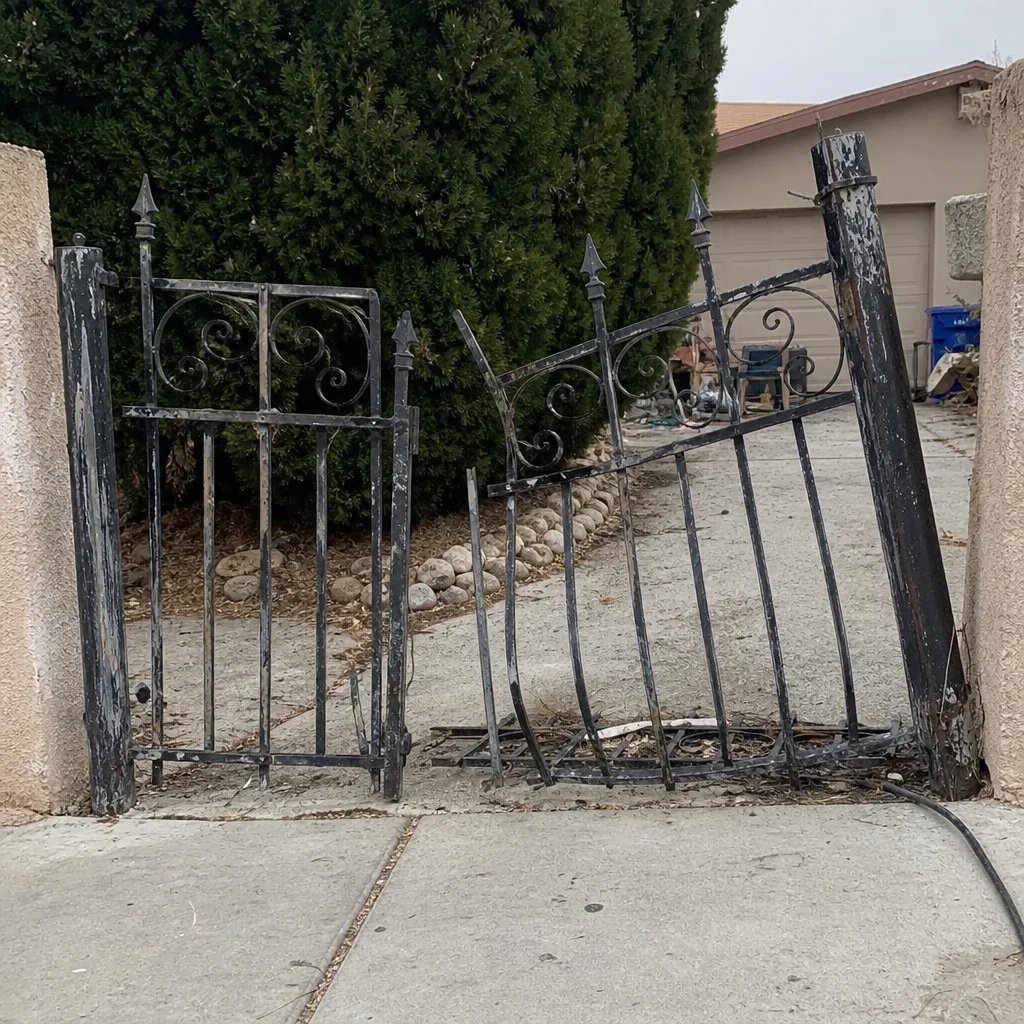 Before
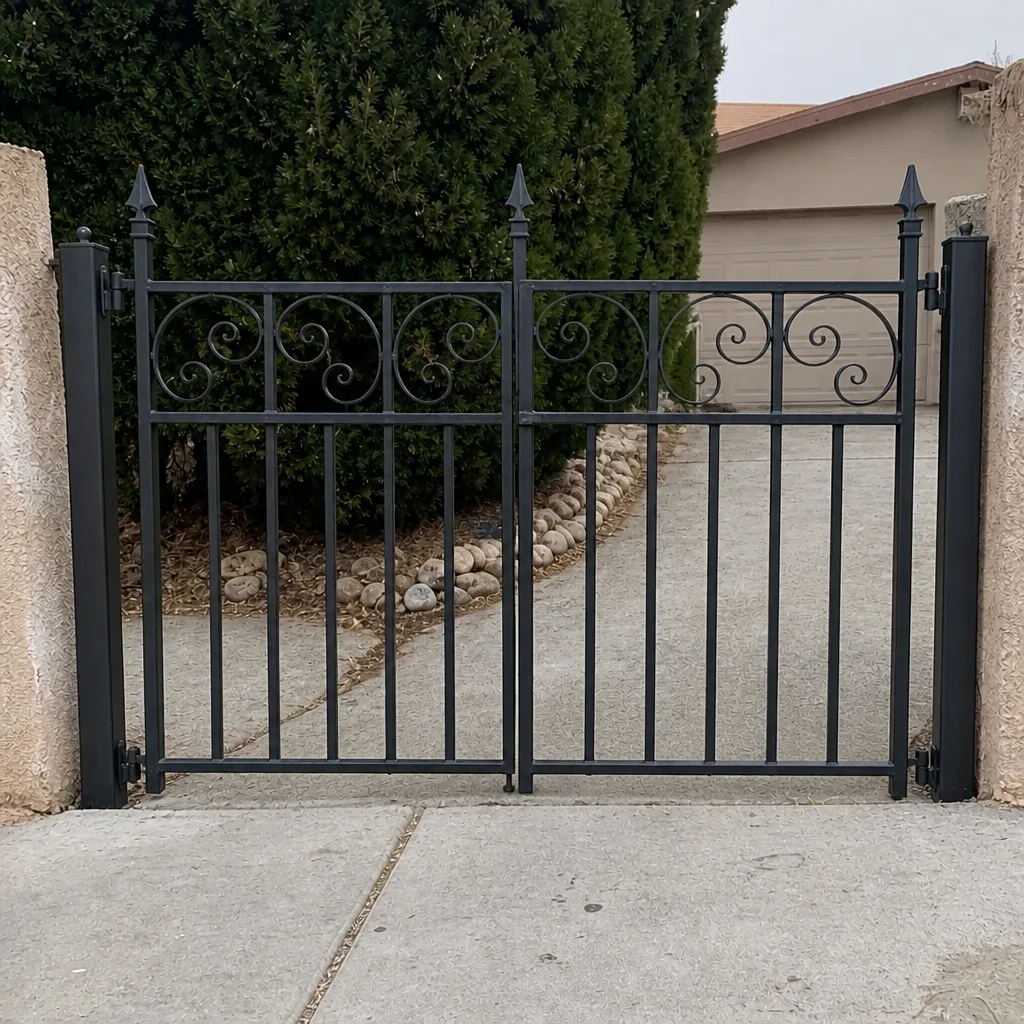 After
Why Documentation Is the Real DIY vs Professional Question
Walk through what happens when a gate fails twice. The first failure gets fixed. Maybe by you, maybe by a technician. The gate works again. Eight months later a different symptom appears: the gate stops reversing when it meets an obstruction, or the arm stalls halfway through the swing. The technician who arrives has no idea whether the original problem was a bad limit switch, a loose bracket, a failing battery in a solar setup, or a control board that was already on its way out.
So they start from zero. They meter the board, test the photo-eye alignment, cycle the gate manually, and pull the cover off the operator to trace wiring. All of that takes time, and time is what you’re billed for. In our experience, a gate with no service history routinely adds 30 to 60 minutes of diagnostic work to a repair that would have taken fifteen minutes if the previous technician had left a note saying “replaced limit switch, set travel to 88 degrees, part #X.”
That’s the frame this whole guide hangs on. A DIY repair isn’t inherently worse than a professional one. An undocumented repair is worse, whatever the source. And a professional repair that arrives without a written scope or a photo record is barely better than DIY in the long run. This is why we work under what we call The Haven Standard: written price before work starts, a photographed record on every visit, and the 365-Day Done Right Promise covering everything we complete. If a repair isn’t right, we make it right at no additional charge for a full year. Not because we’re generous, but because the record tells us exactly what we did and when.
What a Boulder City Homeowner Can Safely DIY (And What to Log)
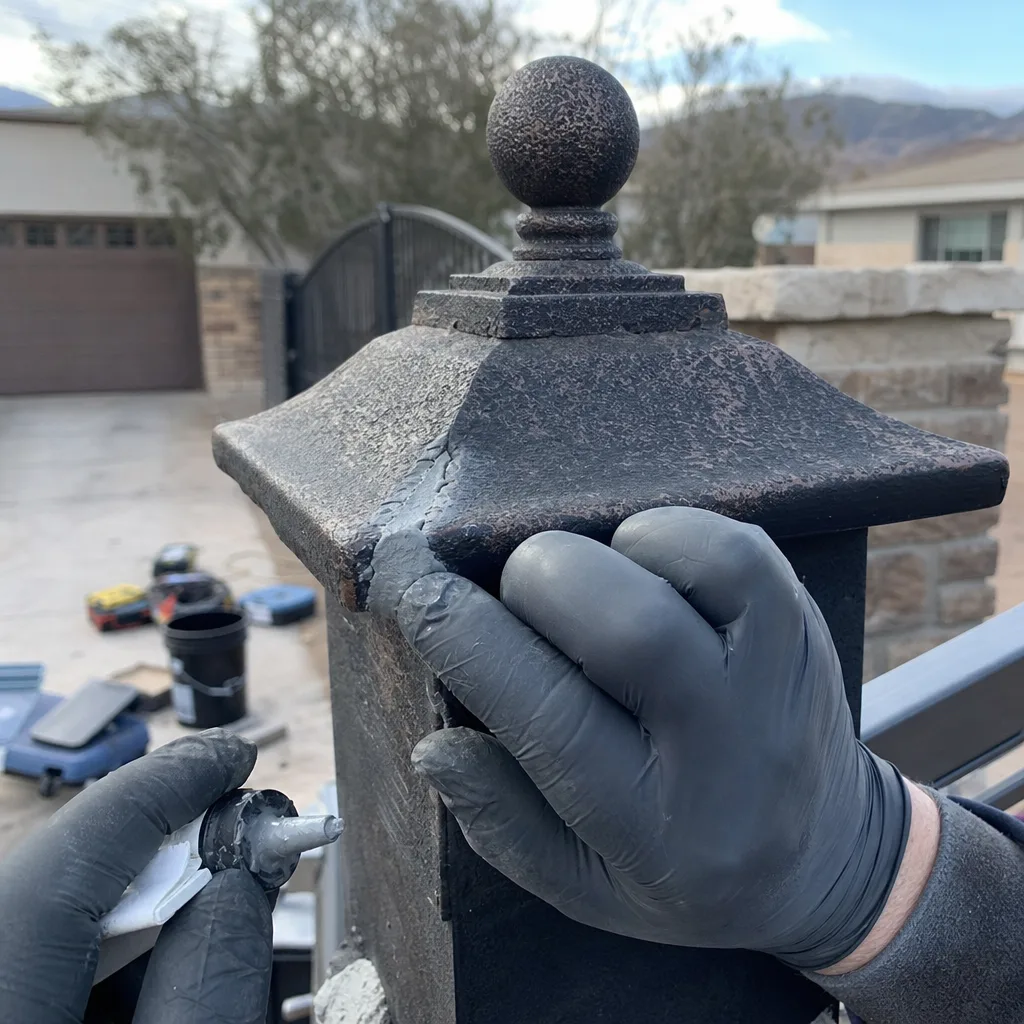
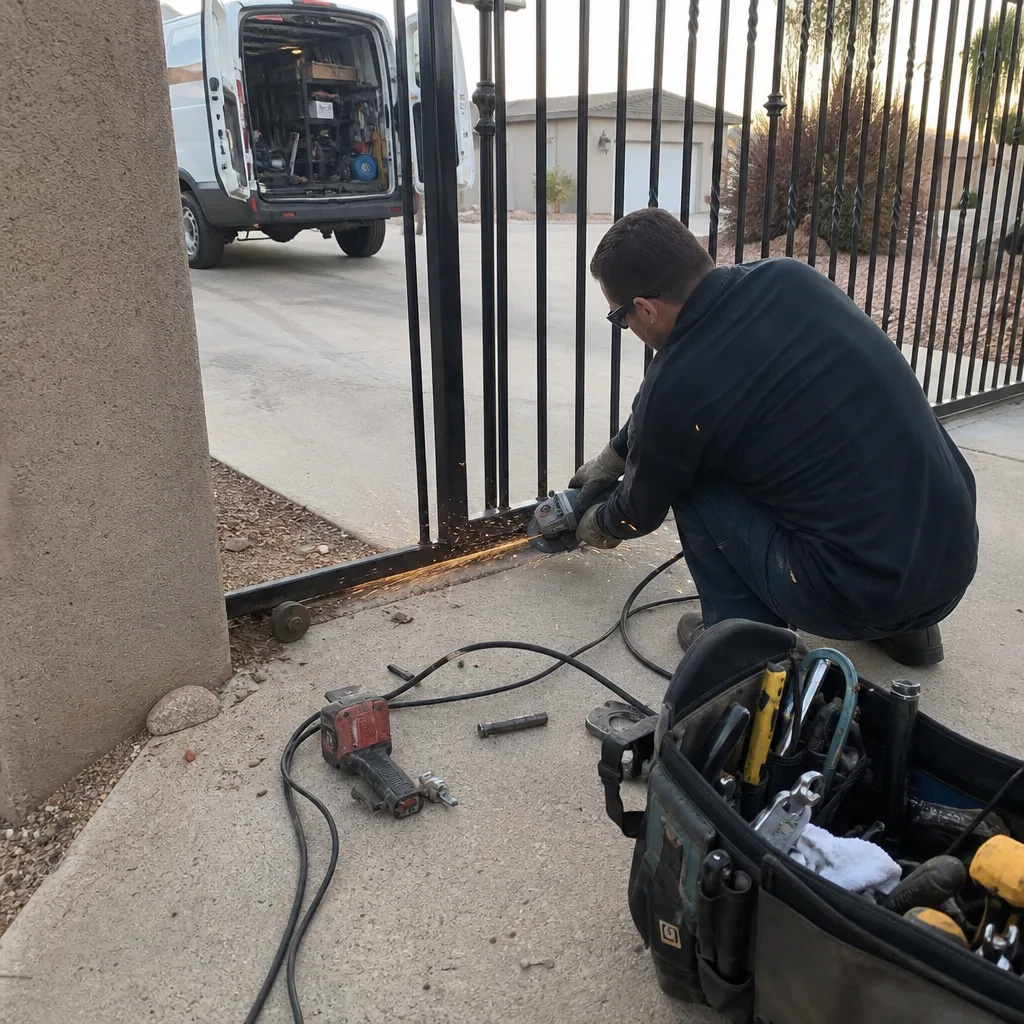
Plenty of gate maintenance is genuinely safe to handle yourself, and we’d rather tell you which jobs those are than pretend everything requires a technician. Here’s the split, organized by what you’re touching.
Safe to DIY with a record
- Hinge lubrication. A few drops of a lithium-based lubricant on each hinge, twice a year. Log the date and the product.
- Track and roller cleaning. Sweeping grit out of a sliding gate’s track prevents the binding that wears out rollers early. Photograph the track before and after.
- Photo-eye cleaning and rough alignment. The infrared beam that stops the gate if something crosses its path. If the lenses are dirty or knocked slightly out of line, cleaning and nudging them back is low-risk. Log the alignment position if you touch it.
- Battery checks on solar and backup systems. If your operator runs on a solar panel and battery, testing voltage with a multimeter and noting the reading is safe and useful.
- Visual inspection of the operator housing and posts. Loose bolts, rust bloom, water intrusion after a storm. Photograph and note it.
- Manual release testing. Every automated gate has a manual release key or lever. Testing it once a season and confirming the gate swings freely by hand is safe and tells you a lot about the operator’s health.
What to log every time
Whether you lubricate a hinge or just clean the photo-eyes, write down four things: the date, what you touched, the product or part number if you used one, and a photo of the component before and after. Store it in a single folder on your phone labeled with the gate’s location (for example, “Driveway Gate – East Side”). When a technician arrives, hand them the folder. That’s the entire difference between a documented DIY repair and an undocumented one.
What Requires Licensed Hands Every Time
Some gate components will hurt you if they fail while you’re near them. We’re not going to give step-by-step instructions for these, because the risk isn’t hypothetical. Here’s what belongs with a trained professional, every time.
- Torsion and extension springs. These store enormous energy. A spring under tension can release suddenly, and the injury is severe. Never attempt to adjust, re-tension, or replace one yourself.
- Any 120-volt wiring or control-board replacement. If the work requires opening a live electrical panel or landing line voltage on a terminal, it’s a licensed job. This includes swapping a failed control board on a LiftMaster or Linear operator.
- Gate arm and bracket replacement on an automated operator. The arm geometry and bracket alignment determine the operator’s travel and force settings. Getting it slightly off can stress the motor or defeat the safety reverse.
- Limit-switch repositioning on an unfamiliar operator. If the limit switch has drifted and you don’t know the original reference point, resetting it blind can drive the gate past its intended travel and damage the operator.
- Welding or structural post repair. A gate that’s sagging because a post has settled or rusted through needs structural work, not lubrication.
If you’re not sure whether a job falls into this list, err on the side of calling. We’d rather answer a question about a squeaky hinge than take a call about a spring that let go.
UL 325, Nevada Code, and What Self-Performed Work Actually Affects
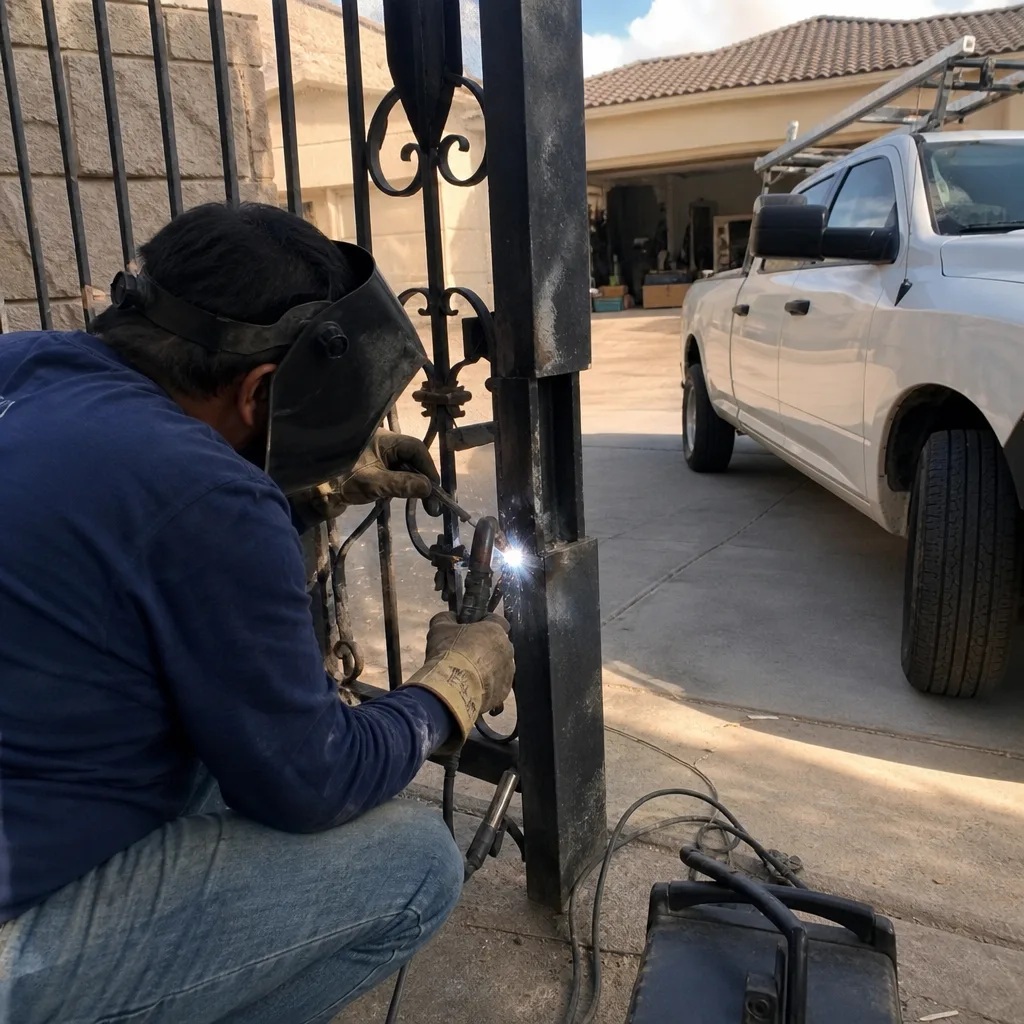
UL 325 is the safety standard governing automated gate operators, and it’s the reason your gate has photo-eyes, a safety edge, or a reversing mechanism at all. When an operator is installed and certified, it’s configured to meet UL 325. Any change to the control board, wiring, or safety sensor alignment can move the operator out of compliance, even if the gate still works.
Here’s what that means practically for a Boulder City homeowner considering self-performed work. First, most manufacturer warranties on the operator are voided by unauthorized modification. If a technician later finds a spliced wire or a non-OEM board in your LiftMaster, BFT, or FAAC operator, the manufacturer can decline a warranty claim. Second, if an automated gate later injures someone or damages a vehicle because the safety reverse was disabled or misaligned, the person who modified the operator carries liability. That’s a real exposure, and it’s why we document every wiring change with a photograph and a note in the job record: proof of what was set and when.
Nevada doesn’t require a homeowner to hold a contractor’s license to work on their own property, but it does require licensed contractors for work on wiring and structural elements that fall under electrical or building codes. When in doubt, call before you open the control box. A five-minute conversation is cheaper than a liability claim.
The Documented Cost Difference: Repair With Records vs Repair Without
Here’s the number that surprises homeowners most. The same failed component costs meaningfully more to repair when the technician has no history, because the diagnostic time is billed at the same rate as the repair. Below is a line-item breakdown of the difference we see in Boulder City, using typical ranges for standard residential swing and slide gates.
| Job | With prior records | No prior records |
|---|---|---|
| Operator diagnostic | $0-$75 (confirmed from log) | $95-$175 (full rediscovery) |
| Limit switch reset | $65-$110 | $130-$210 (includes travel re-mapping) |
| Photo-eye misalignment repair | $75-$140 | $120-$200 |
| Control board replacement (LiftMaster, Linear) | $210-$390 | $280-$480 |
| Battery replacement (solar operator) | $110-$190 | $150-$240 |
The pattern is consistent: the undocumented gate runs 30 to 70 percent higher on the same repair. Those are actual ranges we quote, not estimates rounded up for drama. And this is why we hand over a written price before work starts, every time. Under Haven Standard Clause 1, the flat price is written and given to you before any tool comes out of the case. No surprise invoice at the end, no “call for a quote.” You know what the repair costs, and the next technician will too.
The Decision Matrix: Job Type, Safety Risk, Documentation Burden
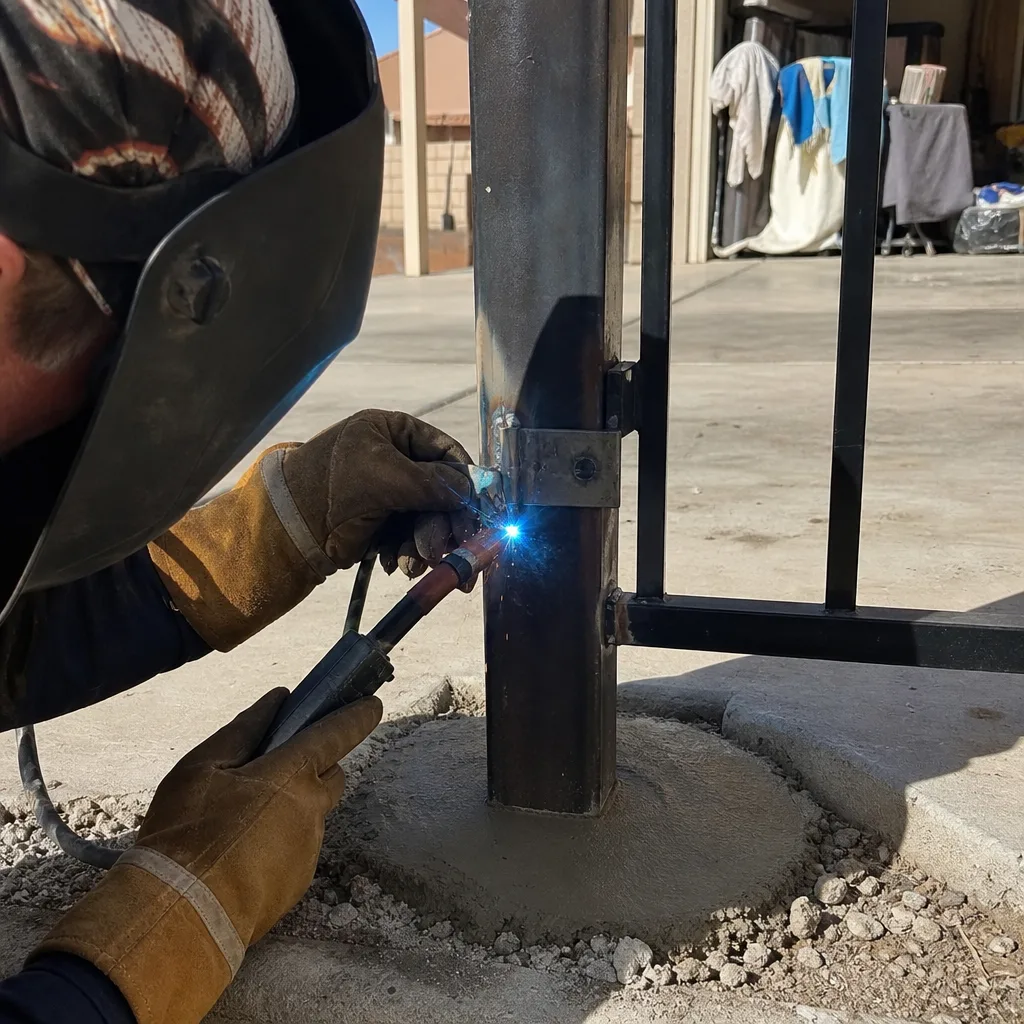
Before you open the control box, run the job through this matrix. It gives you a defensible answer in under a minute.
1. Identify the component
Which part is actually involved? Spring, cable, hinge, track, roller, photo-eye, limit switch, control board, battery, arm, bracket, post, or gate panel.
2. Rate the safety risk
- High risk: spring, cable, any 120-volt connection, arm under force, post under load. Professional only.
- Medium risk: limit switch adjustment, photo-eye repositioning, control board. Professional unless you’re confident and documenting.
- Low risk: lubrication, cleaning, battery testing, visual inspection, manual-release testing. Safe to DIY with a record.
3. Measure the documentation burden
Ask yourself: if a different technician opens this gate six months from now, what would they need to know? If the answer is “the part number, the setting, and a photo,” and you can produce all three, DIY is reasonable. If the answer is “the wiring order and the travel reference point,” call a professional. The cost of getting it wrong isn’t the repair; it’s the liability.
How to DIY and Still Create a Usable Record
If you’re going to do the safe work yourself, do it in a way that leaves a trail. Here’s the process we recommend, and it’s the same one our own technicians use.
- Photograph before you touch anything. One wide shot of the component in context, one close-up of the specific part you’re changing. Keep both.
- Write down the setting or reading. If it’s a photo-eye, note the position. If it’s a battery, log the voltage. If it’s a limit switch, don’t touch it; log that you didn’t.
- Record the product or part number. The lubricant, the battery, the sensor. A photo of the label works if you don’t want to type it out.
- Photograph after the work. Same angle as the before shot, so the two can be compared side by side.
- Store everything in one labeled folder on your phone. Name it after the gate and location, and back it up if you can.
- Note the date and the reason. “Cleaned photo-eyes because gate stopped reversing on 4/12” tells the next technician more than any purchase receipt could.
Do that consistently and your DIY work becomes an asset rather than a liability. When a professional does arrive, hand them the folder. In our experience at Vance Gate Repair Boulder City home, a homeowner who hands us a photo log gets a faster, cheaper repair than one who doesn’t. It’s that simple.
Common Mistakes to Avoid
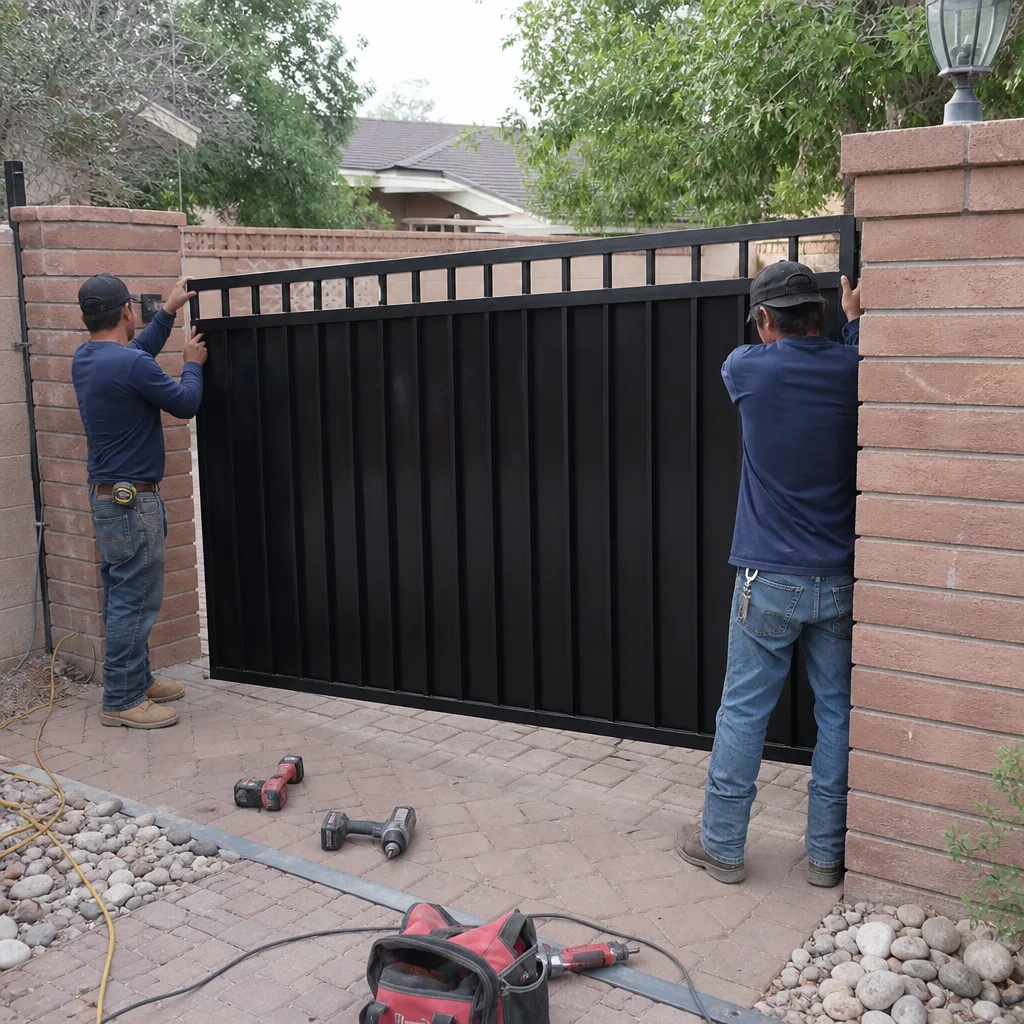
- Adjusting a limit switch without logging the original position. If the gate later overshoots, the technician has no reference point and bills a full travel re-map. Mark the original setting with a marker before you touch it.
- Disabling or bypassing the safety reverse because the gate “keeps stopping.” The gate stopping is the safety feature working. Bypassing it creates exactly the liability UL 325 exists to prevent.
- Replacing a control board with a non-OEM part to save money. It voids the operator warranty, and we’ve seen it on LiftMaster and FAAC units in Boulder City more than once. The savings are eaten by the next repair.
- Overtightening hinge bolts to “fix” a wobble. It deforms the gate frame and shifts the load onto the operator. Torque to the manufacturer’s spec, not to feel.
- Greasing a roller track that should be dry-run. Some track profiles need a dry lubricant or none at all. Grease attracts grit, and in Boulder City’s dusty spring wind, that grit wears the rollers faster.
- Doing the repair without a photograph. The single most expensive omission. A five-second photo prevents an hour of diagnostic time six months from now.
- Assuming a verbal estimate from a professional is the written price. It isn’t. Get it in writing before work starts, and ask for the photo record at the end. If a company won’t provide either, that’s the answer to whether they’re the right call.
See the difference
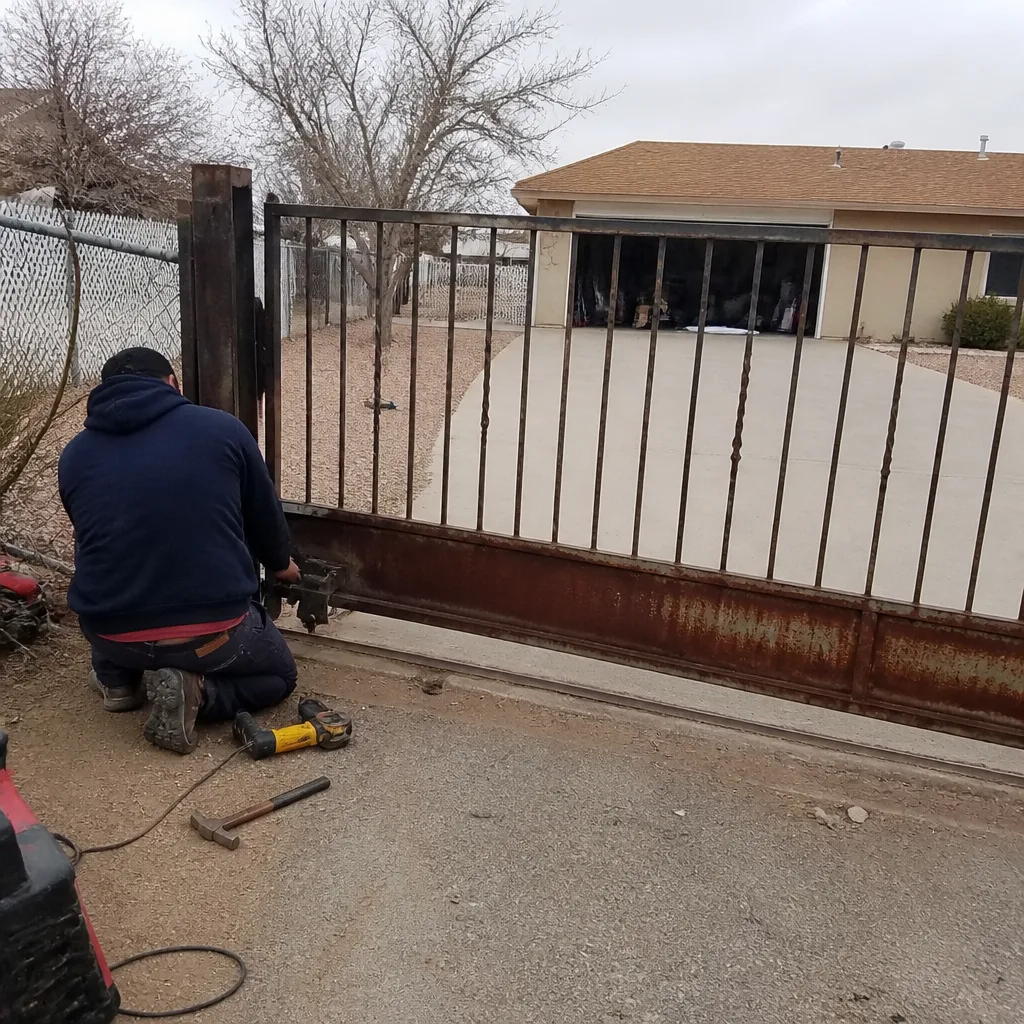
BeforeAfter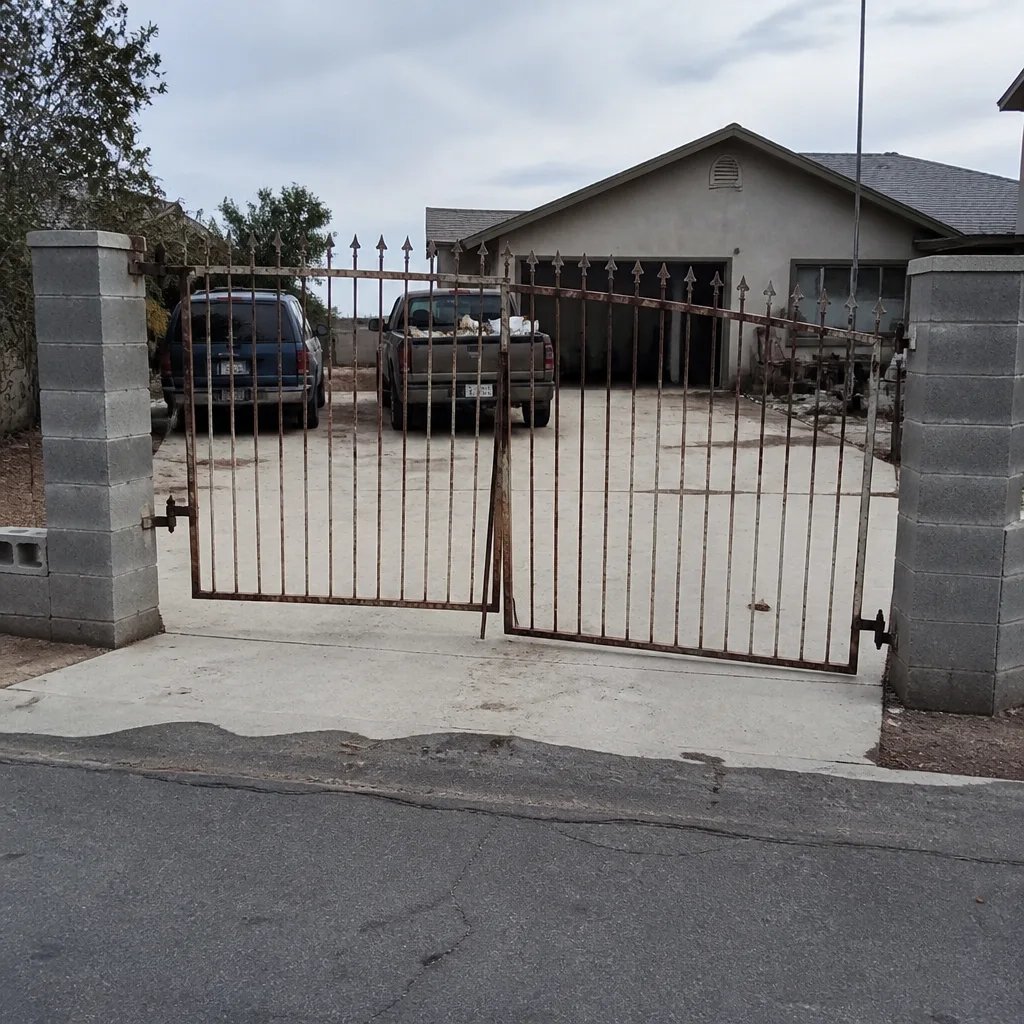 Before
 After
 Before
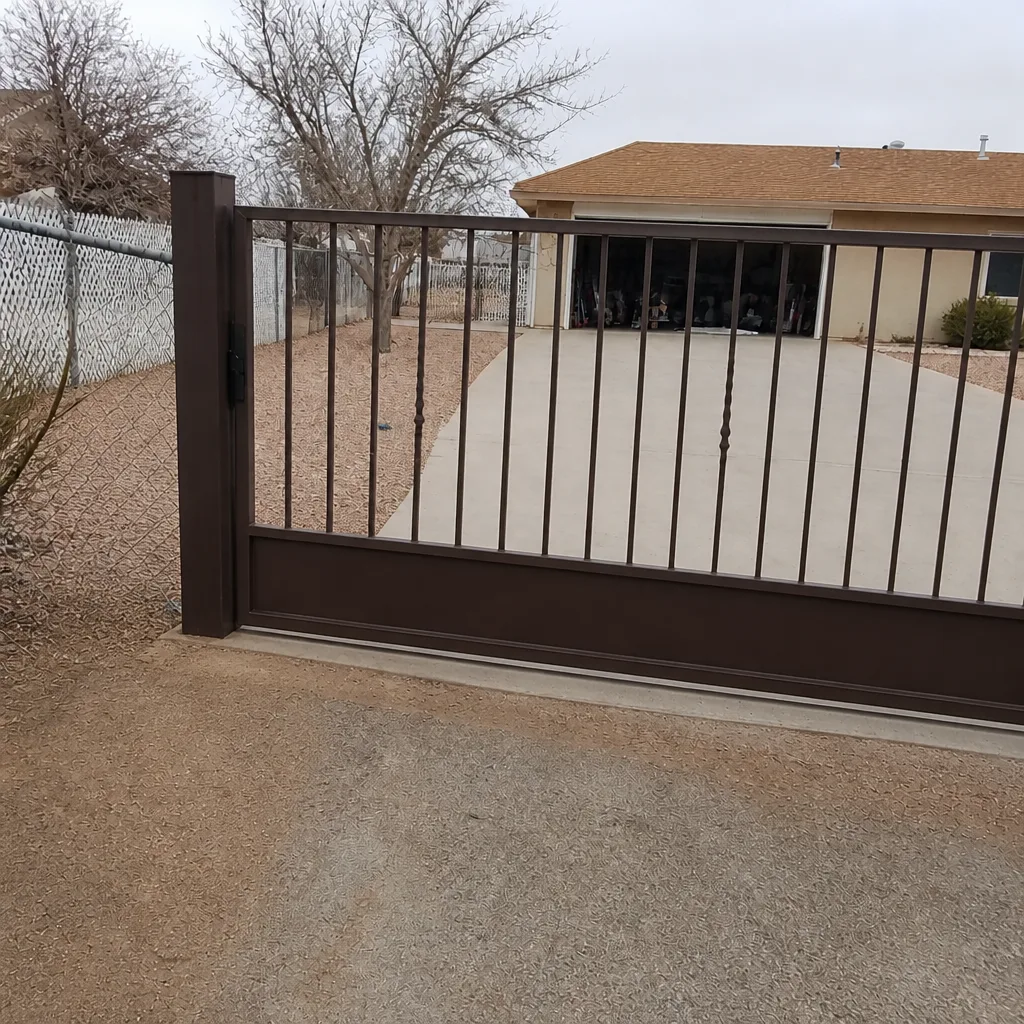 After
When to Call a Professional
Call a licensed technician the moment the job involves a spring, a cable, any 120-volt wiring, a control-board replacement, or a gate arm under load. Call if the gate is a structural problem, not a lubrication problem. Call if you’ve opened the operator, looked at the wiring, and felt unsure. And call if you’re tired of rediscovering the same failure every season with no way to know whether it’s new or old. That last one is what a documented service record solves, and it’s what we do on every visit: the photo log gets left with you and filed in the job record. Vance Gate Repair Boulder City offers free estimates in Boulder City. For a gate repair in Boulder City, a second opinion on a written estimate from another company, or a clearer picture of what’s actually wrong with your operator, call (844) 320-7587. A live person answers at any hour.
Frequently Asked Questions
For low-risk jobs like lubrication, photo-eye cleaning, and battery testing, DIY is cheaper today. But over the life of the gate, the undocumented DIY repair often costs more because the next technician bills diagnostic time to rediscover what you did. In our experience, the documented repair runs 30 to 70 percent lower on the same failed component. Call (844) 320-7587 for an exact quote on a specific repair; estimates are free.
Often, yes. Most manufacturers void the operator warranty for unauthorized modification, and that includes non-OEM control boards and wiring changes. Our technicians have up to 12 years of experience and work on LiftMaster, FAAC, BFT, and Linear units, among others. If you’re not sure whether your repair falls under the warranty, ask before you open the control box. A free estimate will tell you what’s actually covered.
Cleaning and rough alignment of the photo-eyes is safe to do yourself, and it’s one of the most common fixes for a gate that’s stopped reversing. What needs a professional is repositioning the sensor mount or re-wiring the sensor, because both affect UL 325 compliance. Log the position you moved it to, and photograph the setup. If the gate still won’t reverse after cleaning, call (844) 320-7587 and we’ll come look.
A professional repair under our standard includes three things DIY doesn’t: a written price before any work starts, a documented photo record of what was found and what was set, and the 365-Day Done Right Promise covering the completed work for a full year. The documentation is the part that lowers your future repair costs. Bring us a written estimate from another company and we’ll review it at no charge as a free second opinion.
Most professional repairs on standard residential gates run $75 to $390 depending on the component, with diagnostics ranging from confirmed (no charge) to a full rediscovery ($95 to $175). DIY material costs are lower, but a professional repair comes with a written price before work starts and a documented record. For an exact number on your gate, call (844) 320-7587; the estimate is free. Don’t accept a verbal number from anyone.
Usually, yes. We keep a live person on the phone 24 hours a day, so you’ll reach a real technician at any hour. Same-day repair on standard components like limit switches, photo-eyes, and batteries is common. Bring your attempted-repair notes and photos if you have them; they cut the diagnostic time. Call (844) 320-7587 for a same-day appointment and a written price before work begins.
The Bottom Line
The DIY vs professional question isn’t really about your skill. It’s about what happens to your gate’s history every time someone touches it without writing anything down. Do the low-risk jobs yourself, but log every one of them with a date, a part number, and a photo. Leave springs, cables, wiring, and operator brackets to a licensed technician. And whichever route you take, insist on a written price before work starts and a photo record when it’s done. That combination is what protects the next repair from becoming more expensive than it should be. When you need a hand, we’re at gate motor and opener service in Boulder City as well as new gate installs (gate installation in Boulder City), and we’d be glad to take a look at whatever your gate is doing.
Whatever your gate is doing right now, the smartest first step is a written price and a clear diagnosis. Call Vance Gate Repair Boulder City at (844) 320-7587 for a free estimate. We’ll show you what we found, put the price in writing before we touch a tool, and leave you with a photo record for the future.
Written by the team at Vance Gate Repair Boulder City.